Your Path to Breakthroughs: Insights from Jan McDonald
From hopeless drunk to 30 years sober and helping hundreds of individuals and organizations unlock their ‘and then some’, I distill all the lessons gained from those transformational life experiences and share them with you in this space.
I invite you to explore these insights as way to help you breakthrough the challenges that are stopping you from becoming who you want to be.
A couple of years ago, I co-led a presentation called Presentations: Connection With Your Audience. My co-presenter was incredibly charismatic. He moved all over the stage and had a completely different presentation style than I did. I had seen him speak before and I thought to myself, “I’m not like him at all. How can I present with more pizazz like him? Will they even want to hear me after he speaks? “
And then I caught myself. Wait a minute. I’m me. In fact, I realized it might be good for the audience to see two very different presentation styles—and see that both could be effective.
And they were. The presentation was a hit!
I wish I could tell you I never struggle with comparing myself to other speakers anymore. I do. The difference is that now I recognize it sooner and change the conversation I’m having with myself.
I don’t need to speak like them. I need to be me. I have something valuable to bring, too. That positive self-talk matters.
That experience taught me something I’ve never forgotten: You don’t have to become someone else to connect with an audience. Learn from great speakers. Try new techniques. Stretch yourself. But don’t lose you in the process.
Your stories. Your personality. Your humor. Your way of connecting. That’s what makes your message yours.
Your audience needs you…just as you are!
That’s one of the things we’ll talk about in Mastering Your Message—becoming a better communicator without becoming somebody else.
“Good communication isn’t about saying more. It’s about saying what matters.”
–Jan McDonald
Have you ever walked away from a conversation, meeting, or presentation and thought, I wish I had said that differently?
I have. One thing I’ve learned is that a strong message usually starts before we ever open our mouth.
Before your next important conversation or presentation, ask yourself three questions:
1. What do I want them to KNOW? What is the one thing they need to understand?
2. What do I want them to FEEL? Encouraged? Challenged? Confident? Motivated to act?
3. What do I want them to DO? What is the next step you want them to take?
When we aren’t clear about those three things, our audience probably won’t be clear either.
And here’s the good news: great communicators aren’t necessarily born that way. Communication is a skill—and skills can be learned. That’s exactly what we’ll be working on in our upcoming Mastering Your Message Workshop—how to organize your thoughts, communicate with confidence, and create a message people understand and remember.
If you’d like to strengthen the way you communicate, we’d love to have you join us.
“Make sure you’re not sabotaging something that has the potential to be fruitful and great.”
–anonymous (but I’d like to make it mine:)
I’ve taught on Self-Sabotage many times. I thought I would share some of the brilliance that came from participants on a call in my coaching group.
The idea for this content came about because there were areas where I was sabotaging my success and I wanted some answers. So as not to blow anyone’s cover, I’m not going to be using any names of the geniuses behind this email…unless, of course, it’s me:) Self-sabotage is cunning–most of the time we are not aware that we are doing it. We get caught in the web of our subconscious mind and old programming. Occasionally, I get caught up in that web still.
This first wisdom shared on the call was that overthinking was sabotage. This person called it “ruminating,” like when a cow chews its cud. Overthinking the problems rather than the possibilities, is paralyzing. Taking action is not even on the radar screen. The words used to describe this sabotage, “The possibilities only happen when I take action. All the things that I think are problems would not be problems if I would act, even if I didn’t know how it would turn out. It never turns out the way I think it will anyway.” Someone said that more than 90% of things that we worry about never happen anyway.”
Another person shared that sabotage had to do with age and he/she was totally unaware that he/she was using this to hold themselves back in areas. One of the areas was learning new software and technology. Another one was eating unhealthy things at night. They felt they deserved to eat this way because they were older.
Another participant shared about self-talk and how we believe lies about ourselves that cause us to sabotage.
We also came to the conclusion that sabotage is selfish. WHAT? How could that be? We don’t live on an island, others are impacted by our behavior. Think about some of the habits or conditioning that we have. We don’t think we are worthy to have the good in life. We procrastinate because there’s always tomorrow. We compare ourselves to others. Maybe we fear intimate relationships, so we push away those we love. We drink, eat, tweet and facebook too much. We can’t control our anger in conflict. Think of this list in terms of relationships and the resulting impacts on our relationships.
Lastly, we all came to the conclusion. it is selfish to the One who created us. Your worldview may call that One the Universe, the Source, Intuition or whatever. I call Him God. God has given us all of these talents and gifts so we can make a positive difference in His world. When we behave in ways that are “less than” who we know we can be, we are hiding our brilliance, gifts and talents under limiting beliefs that don’t serve us or anyone else for that matter.
Here’s a couple of short tips to help you overcome sabotage. Watch for self-sabotaging behavior and pause momentarily the next time you recognize it. Identify the feelings behind it. Why am I doing that yet again? Why am I reacting this way? What do I want to get from this behavior? How’s that working for me? Most of the time it isn’t working.
Create an positive affirming statement to combat the negative thinking that is taking place in your mind. How do I want to feel? What would I rather respond instead? Imagine yourself overcoming, because you can. You get to choose our thoughts and actions.
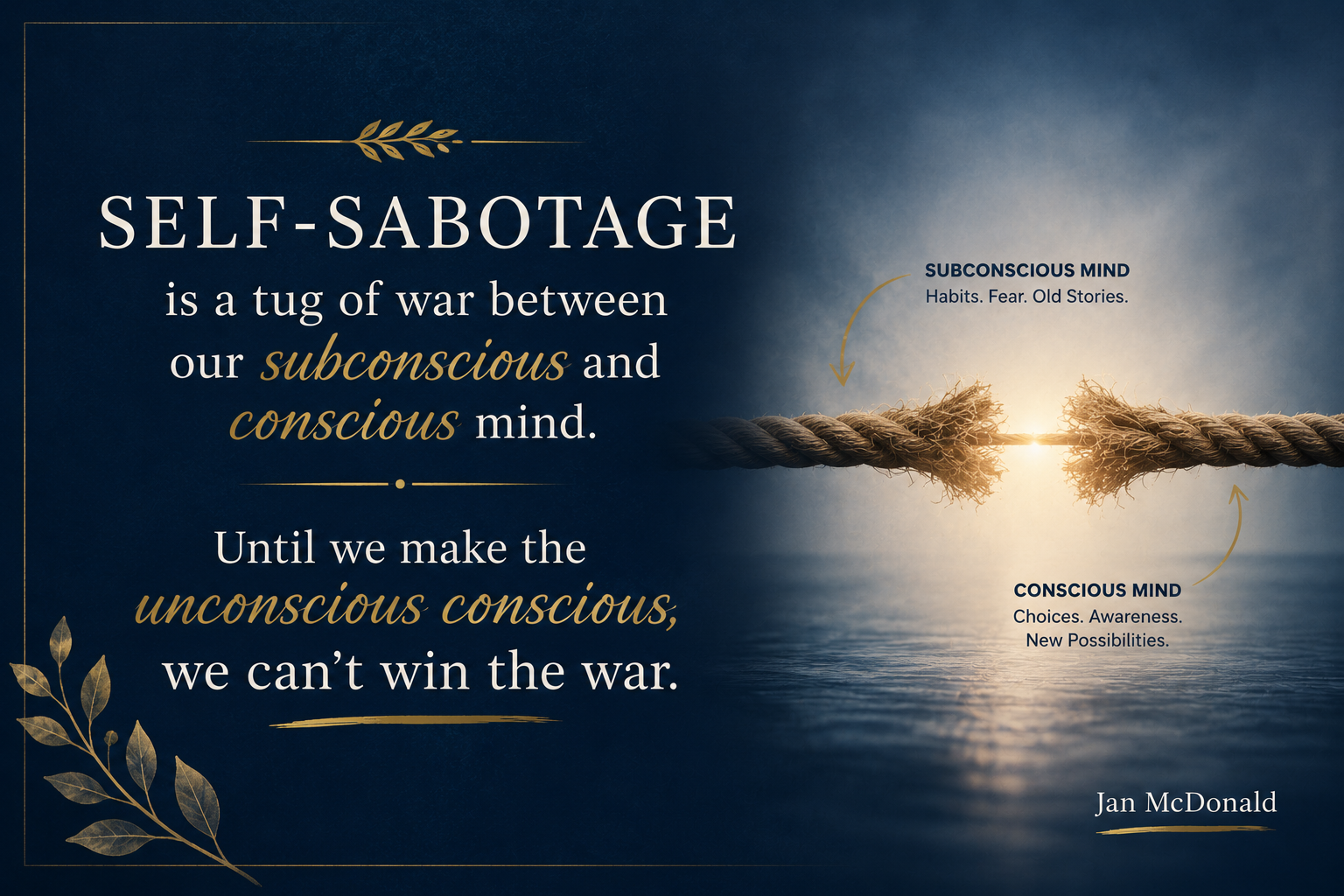
Self-sabotage is a tug of war between our subconscious and conscious mind. Until we make the unconscious conscious, we can’t win the war.
If you need help with self-sabotage, email me. I’m starting another group coaching soon; let me know if you want to be part of it.
“Leadership ability is always the lid on personal and organizational effectiveness.”
–John Maxwell
I learned the Law of the Lid the hard way when I was the CEO of a nonprofit. When I stopped growing my leadership skills, the organization stopped growing. Period.
John Maxwell teaches in The 21 Irrefutable Laws of Leadership that our leadership ability determines our level of effectiveness and influence.
We are either growing or dying. There’s no middle ground.
But I’ve come to realize our “lid” isn’t just about leadership. We can have lids in our relationships, our health, our mindset, our emotional resilience, and even our sense of purpose. Wherever we stop learning, stretching, and growing, we eventually limit what’s possible.
The good news? Your ceiling is your choice.
And one of the best ways I know to raise your leadership lid is to intentionally put yourself in places where you are challenged to think bigger and lead better.
That’s exactly why I’m so excited about Live2Lead Tri-Cities on October 22.
This year, we’ll learn from:
John C. Maxwell–one of the most respected leadership experts and author of more than 110 books Dan Heath--bestselling author or coauthor of six influential business books Kathryn McLay–former CEO of Walmart International, where she led more than 500,000 people across 18 countries Rory Vaden–bestselling author and expert on self-discipline, productivity and influence Stephanie Chung–began her career handling baggage and rose to become the first African American president of a private aviation company.
If you’ve been thinking about investing in your own growth—or the growth of your team—this is a great place to do it.
My experience is that complicated people are a gift. I learned the most about humility, communication and leadership from the people who challenged me the most.”
–Me
Good Monday morning!
Have you ever noticed that the most difficult people in our lives often become our greatest teachers?
Last week, I shared four questions during my From Complicated to Connected workshop. They aren’t complicated, but if we answer them honestly, they have the power to transform the way we lead, communicate, and build relationships.
These questions come from Ryan Leak’s book, “Working With Complicated People.”
1. What’s it like to be on the other side of me? We all know our intentions. Everyone else experiences our actions. This question builds self-awareness and helps us see ourselves through someone else’s eyes.
2. What’s my part? When relationships become difficult, it’s tempting to focus on what the other person did. Great leaders ask a different question: What part do I own? Growth begins when we stop looking for blame and start looking for responsibility.
3. What’s it like to be them? Curiosity changes conversations. Before making assumptions, pause and consider what pressures, fears, or priorities the other person might be carrying. Understanding doesn’t always mean agreement—but it almost always creates connection.
4. What brings us together? We all want to be valued, understood, and respected. When we focus on what we have in common instead of what sets us apart, we stop seeing people as problems to solve and start seeing them as people to understand. That’s where real connection begins.
Relationships rarely improve because someone else changes first. They improve when we ask better questions. I didn’t always like the answers to those questions…maybe that’s why complicated people are actually a gift. They help us become the kind of people we couldn’t become on our own.
This week’s challenge: Choose one relationship—at work or at home—and intentionally ask yourself these four questions before your next conversation. You may be surprised how differently you listen, respond, and lead.
Have a wonderful week!
Think and believe differently so you can become more than you thought possible,
“You don’t have to live from a picture someone else painted years ago. You get to choose a new one.”
When you look in the mirror, who do you see? Not your reflection. I’m talking about the picture you have of yourself on the inside. That’s your self-image.
When I was in elementary school, I was always the smallest kid on the playground. Every time teams were chosen, I was picked last. “She’s too little. She can’t help us win.” My teacher, Miss James, would finally step in and make someone choose me.
As a child, I couldn’t separate those words from my identity. I began to believe that being little meant I wasn’t enough.
That’s how a self-image is formed. When we’re young, we don’t have a filter. We believe what people say about us. Our experiences, our successes, our failures, and the words we hear begin painting a picture of who we think we are. The problem is, some of those pictures aren’t true anymore.
Have you ever noticed how easy it is to imagine the worst? We do it all the time when we worry. We picture the worst case scenarios, don’t we?
So why not visualize the best?
Why not begin seeing yourself as the person you want to become? The person who is calm under pressure. The one who communicates with confidence. The one who encourages others. See yourself as successful.
Elite athletes visualize success before they ever step onto the field. They mentally rehearse becoming the person they want to be. We can do the same. Start acting as if you are becoming that person. Speak up. Take the next step. Volunteer. Have the conversation.
Over time, your actions begin catching up with your new picture of yourself. You don’t have to live from a picture someone else painted years ago. You get to choose a new one.
Today, I’m still little. But I don’t think of myself as “little” anymore. I had to erase the picture a little girl believed and intentionally replace it with the picture that I chose to believe.
Reflection: What old picture of yourself is it time to replace? What new picture will you begin believing this week? If you need help with this, I’m an email away.
“Journaling is like whispering to one’s self and listening at the same time. “
― Mina Murray
When I first sobered up, everything made me mad. That was my “go-to” emotion and I wasn’t aware of any other feelings. One time, I was ranting to my sponsor, Sharon, about something that p%*sed me off and she interrupted my tirade, “Jan, I don’t think this emotion is anger. I think it is some other feeling.”
What? Do you live in my head so you can know my feelings? Of course, I didn’t say that out loud, but even her answer made me mad. Her suggestion to me for the next time that I felt anger was to get a pencil and paper and write about it. Just write…no punctuation, no grammar, just write. She said that something happens between the brain and the pen. (This is true, but the scientific explanation is too long for this email.) I would probably become aware of emotions that I didn’t know that I had.
I snidely answered, “That sounds like a great idea, but I don’t have time for that.”
Her answer? “If you want me to remain your sponsor, you’ll find time.” I didn’t think I could find another sponsor; nobody would have me.
She was absolutely right. I found emotions that I didn’t know existed. When I didn’t understand something or someone, writing helped me unlock the mystery. It was so beneficial that I still do it today.
Journaling benefits:
I can look back and be reminded about my accomplishments and successes, which my Committee (my head voices) conveniently likes to forget. I put my prayer requests in my journal, as well. You wouldn’t believe the amount of stars (those signify answered prayers) are in my journal.
Journaling gives me reasons to be grateful and helps me stay committed to becoming a better me.
Oh yeah, I can also look back and learn lessons that I might have missed, or chose to ignore. (Smiley face here.)
How to Get Started?
Buy a dollar store notebook and pen.
Just observe yourself for a couple of days. What are your feelings? Are there any emotions that regularly occur? Jot them down. What are they and what triggers them?
Be sure to jot down the fabulous things that are happening in your life, no matter how small.
Write your prayer requests–this is my personal favorite. Often I forget what I’ve asked for, but if they are written, I can watch for how God showed up to answer.
When a challenge arises, sit down with your pen and notebook and just write. No grammar, no punctuation, no perfection…just write. Write until you can’t write anymore. If you are not in a position to write, rant and record on your phone. Have Siri take a long note.
You will be surprised what solutions you come up with and what emotions you uncover. You’ll be excited about all the great things you have accomplished. You will joyfully remember what you asked God for and how He answered. You’ll be grateful that you had that rant with Siri or your notebook and not that person with whom you wanted to argue.
If you have any questions, please ask. I believe journaling has kept me sober, but more than that, it is the reason behind my confidence in undertaking risk and opportunity. I KNOW it will be beneficial to you, as well.
“You don’t have to be amazing to start, but you have to start to be amazing.”
–Anonymous
I just got back from a difficult hike on Badger Mountain. I experienced an incredible amount of gratefulness as I reflected on my life. I’m healthy and fit; I love my calling as a coach/trainer/consultant; I live in a gorgeous area; I get to live in America; I have an amazing family–the list could go on.
I remembered my most amazing fitness feat before I decided to get healthy was getting from the couch to the refrigerator to get wine, beer, tequila….
Before I quit drinking and drugging–I had every excuse; “I don’t have a problem.” “I’m too young to quit.” “I don’t think I can or want to.” “How will I be able to have any fun?” “I’m afraid, because I’ve tried so many times and failed.” I was getting ready to get ready to live my life in a totally different way.
Many people get ready to get ready. Maybe you would like to learn to play the piano. You research teachers in your area and maybe even call around for schedules but then you stop short of setting up your first session. Why is this? Why is it so hard to get started? It’s very simple. Fear.
Fear is a debilitating emotion that can keep us from reaching our full potential. We all have fears and many of us have learned that until we conquer our fears, we are stuck. We can’t start that project or that goal or achieve that which we so desire.
How do we start when we are scared stiff? Instead of working on the fear, let’s try a different approach and let’s look at the end result. Using the piano example, maybe this has been a dream all your life to learn but you never had the chance; circumstances got in the way. And now you have the time and you have the means to get the lessons but you are afraid. What if you stink at it? What if you are too old to learn? What if you can’t master the keys and the chords? So what! So what! You will never know unless you try. And try more than once, because failing is part of succeeding.
I failed many times at recovery. It took me years to get ready. When I finally embraced and fearfully stepped into my vision of clean, sober and healthy Jan, I was able to move in the direction of that vision–one day at a time.
Think about your vision, your dream of playing that concerto piece you love so much. Or playing that Billy Joel song. Whatever your vision is, if it’s playing the piano – that is what you need to focus on every day. Every time you get scared, every time you doubt yourself, see yourself at your first recital playing a piece you practiced for hours and hours, day after day and now you are ready to play for a group. Imagine yourself experiencing the enjoyment of reading the music sheet and then turning the notes into actual music – pouring out of the piano – imagine how that would feel.
“The world will never starve for wonders, but only for wonder.”
--G.K. Chesterton
I facilitate a Bible study on Tuesday nights with “kids” between 30 and 40 years of age. Last Tuesday, we studied the word “profanity.” The definition that we came up with for profane was to treat something holy as though it were ordinary, common or of little value. It wasn’t just about the words that come out of our mouths.
In my personal Bible study, I’ve been discovering what it means to have a childlike heart. Did I even know what that meant? I came to the conclusion that I didn’t. I grew up in a home where my dad was an alcoholic. Looking back, I realize I didn’t experience childhood the way many children do. I was often watching what was happening around me instead of simply being a kid.
One characteristic of children is that they have this natural sense of wonder. It seems like nothing is ordinary or common to them; a butterfly, a funny cloud, a bug, a flower. Children call these things, “Wow! They notice things that adults walk right past.
Somewhere along the way, I lost my natural sense of wonder. I realized I needed to redevelop my capacity for it. In a world that is busy, noisy, and chaotic, we need wonder to bring us back to sanity. Wonder slows us down, opens our eyes, and reminds us that God is still at work in the ordinary moments of life.
Imagine waking up tomorrow and intentionally looking for things that fill you with wonder:
The first cup of coffee
A flower blooming on Badger
The rainbow while it’s still raining
The song of the birds
The sunset
Being able to breathe
God’s grace
Let’s not miss the extraordinary.
Before you go to bed each night, write down one thing that filled you with wonder that day. It doesn’t have to be spectacular. Pretend you’re a kid again. Look for the butterfly, the rainbow, the bird singing outside your window, or the smile on someone’s face.
Maybe life hasn’t become more ordinary. Maybe we’ve become too busy to notice what’s been there all along.
Little did I realize that my desire to add value to others would be the thing that added value to me.”
–John Maxwell
When people think about you, do they say to themselves, “My life is better because of that person?” The answer to that question probably answers the question of whether you are adding value to them.
Leadership requires serving others and intentionally making them feel better. For awhile, I thought that influencing people happened because I was the leader:) Looking back, I can see that my task-oriented nature created a blind spot. Thank goodness for Gina! Gina was a team member that was brave enough to tell me when my actions “sucked, and you need to apologize.” I am forever grateful for her! I’m still growing in that area.
Zig Ziglar says, “You can get everything in life you want if you help enough other people get what they want.” How do you do that? How can you turn you focus off yourself and start adding value to others?
John Maxwell gives us three ways in the book “Leadership Promises For Every Day.
Value others first in your thinking. People can tell when they are viewed as a priority or when they are viewed as an interruption.
Find out what others need. Don’t assume, ask questions, get curious.
Meet that need with excellence and generosity. Go the extra mile for people.
I’d like to add a fourth:
Seek first to understand We often listen with the intent to respond, fix, or persuade. Listen with the intent to understand other’s perspective. People feel valued when they are heard.
The goal isn’t always to get something from others, it’s to leave them better than you found them.
“You are the only version of you to ever exist in the universe. You are great, you are powerful, you are special.”
–Merrymaker Sisters
“Enjoy being you!” What?
I was listening to a podcast on leadership and those words stood out to me. Lately, I’ve been too focused on my weaknesses. Big smile here, because I coach and train to focus on our strengths.
Old mindsets can come back if we’re not careful. We always need to be vigilant when it comes to our thinking. We were meant to become so much more. And not just me—every single one of us.
Take a look at our DNA. DNA is a 3-billion-character code that paints a picture of you and me. It’s a picture of our hair color, personality, physical attributes and every other thing about us. Nobody else has the same DNA. You have strengths, talents and gifts that nobody else has.
In a study done by StrengthsFinders, a product of Gallup, who has done decades of research on people’s strengths, consider the uniqueness in your Top 5 themes/strengths. The chance another person has the same group of strengths in their Top 5 is roughly one in 275,000. The AT&T stadium in Texas holds 80,000, so that is nearly 3 1/2 times the stadium’s capacity.
Not quite unique enough? Your strengths are listed in order of your intensity, making the combination of your talents even more distinctive. If you wanted to find someone with the same Top 5 strengths in the same order as you, the odds are one in 33.4 million. That’s nearly every person in the Greater Tokyo Area — the world’s most populous metropolitan area.
THESE ARE JUST THE TOP 5 STRENGTHS!
They test for 34. AND if you add your distinct personality style and your spiritual gifts and your specific talents, less than 1% of the world’s population would be anything like you. YOU, YES YOU, ARE SPECIAL.
For years, I compared myself to other people. If only I were prettier. If only I were smarter. If only I could speak like her. If only I had what he had. But comparison is exhausting because it asks us to abandon who we were created to be.
What if instead of trying to be someone else, we became the fullest version of ourselves?
Martha Graham, a very famous and inspiring dancer, whose works were intended to reveal the inner working of people says this.
“There is a vitality, a life, an energy, a quickening that is translated through you into action, and because there is only one of you in all time, this expression is unique. And if you block it, it will never exist through any other medium and will be lost.”
So, enjoy being you. Not because you’ve arrived. Not because you’re perfect. Not because you don’t have room to grow. Enjoy being you because there has never been another you, and there never will be again.
Written with enjoyment,
Jan
P.S. I recently finished writing an inspirational keynote based on my personal story. It’s about overcoming limiting beliefs, changing our thinking, and becoming who we’re meant to be. If you’re looking for an encouraging message for your organization, I’d love the opportunity to share it.
Nothing so conclusively proves a man’s ability to lead others as what he does from day to day to lead himself.”
–Thomas J. Watson
In the last couple of weeks, I have had these questions come up. “What can I do to have more influence over my supervisor?” “How can I tell my boss he needs leadership training?” “How do I convince people they need leadership skills when they don’t think they do?”
These are great questions. When one is used to being the leader, being told what to do or how to do it isn’t very comfortable. I just had this experience last week. I was volunteering somewhere and each person had their own little niche and it was quite evident that nobody was to interfere or help in their niche. Interesting. What was even more weird, are the feelings that arose when they started telling me what to do. Hmmm…I’m not proud to report that I got a little judgmental inside. I’ve not been in that position for a long time. I had to remind myself that I was NOT a CEO anymore.
So let me give you some answers to those questions from my experience and from (of course) John Maxwell.
1. We need to lead ourselves with excellence and then model that behavior. Remember, we can’t give what we don’t have, AND we don’t get who we want, we get who we are. Great behavior influences those around us for the better.
2. We need to understand what is important to our boss or supervisor. What is the mission of the company from which your leader operates, or should? Really try and connect with your leader by investing in that relationship. John says to be a champion of what your leader desires.
3. We aren’t always right. WHAT? Yes, keep an open mind and be willing to see your supervisor’s perspective. If it is not clear what is desired, ask questions with all gentleness and respect. Show curiosity and an eagerness to learn. Understand that your leader has the overall organizational picture in mind, not just your current situation.
4. Know when to push back and when to back off. We must read the atmosphere of our workplace to determine the best timing to confront or wait for a better time. This doesn’t mean we never bring the situation up again, it just means we discern the right time.
5. Be known as the “go-to” person. Develop the ability and willingness to tackle the tasks given us without complaining (or allowing our judger self to arise:) Make sure our body language agrees, as well, when we say, “Sure, I’ll do that,” even if the task is not our job description.
6. Lastly, on this list anyway…and maybe it should be first. Make it your goal to make your leader successful. Be a team player and lighten your supervisor’s load–when he/she is successful, the whole organization succeeds.
Yeah, if you were one who asked the questions, you probably didn’t want to hear any of this. We already know, especially if we have teenagers or spouses…or bosses, that we are unable to change anyone else. Transformation starts with me.
I can tell you from experience, when I stopped using my position as CEO for power, and started leading, the organization changed. The culture became one of teamwork, everyone pitching in and knowing each others’ job descriptions so we could help each other. Not because I was phenomenal–just ask them–but because good leadership is attractive…to everyone. My team learned to lead themselves with excellence and because of that, I desired to imitate them! Their behavior and success made me and the organization look sooooo good!
Go ahead, model great leadership behavior for those around you. It becomes contagious. If those who lead you are unable to “get it,” your own life will change. You will be transformed in the process and that, my friends, is so worth it.
“Nothing can dim the light that shines from within.”
–Maya Angelou
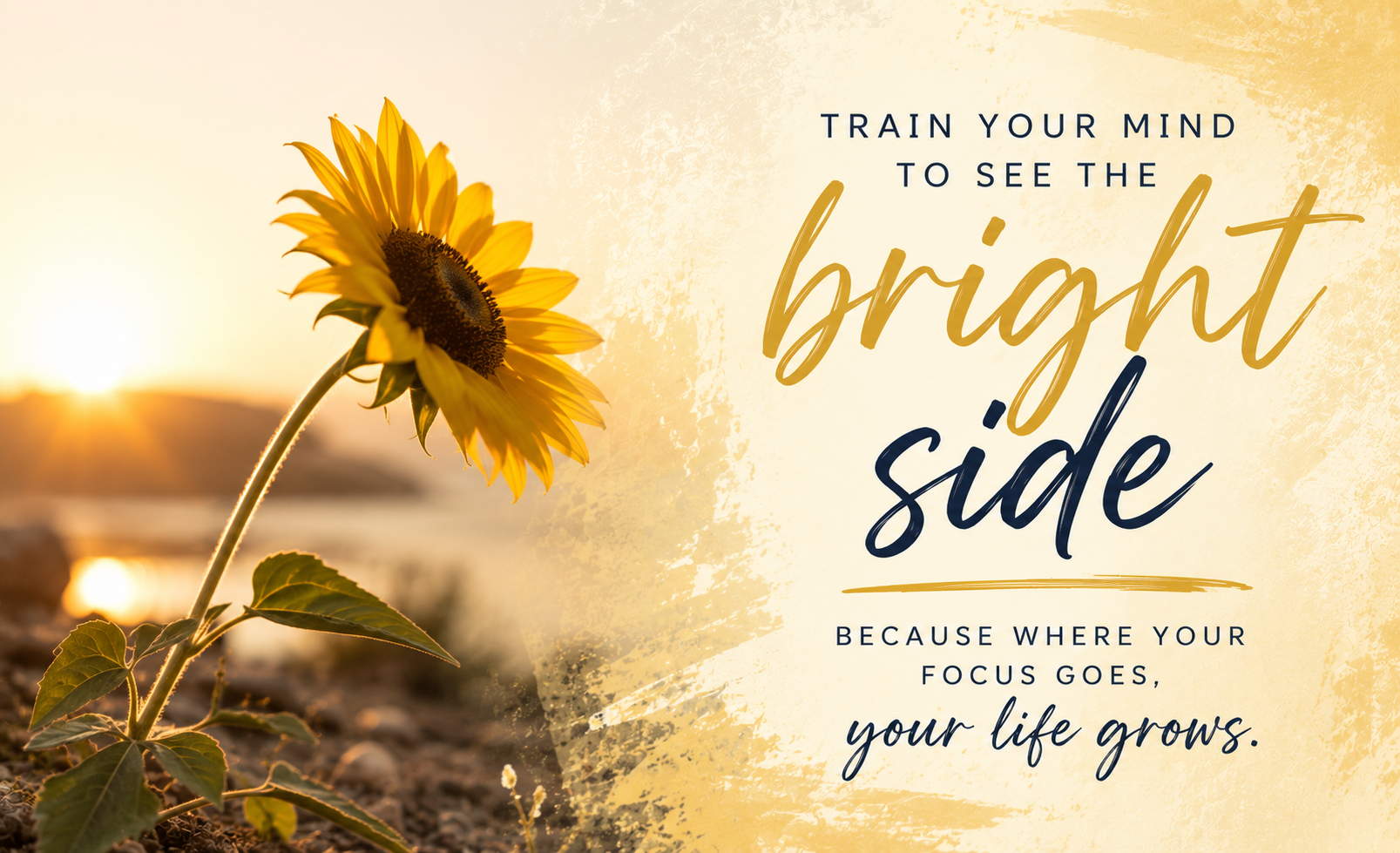
What if we always looked to the bright side?
I’ve noticed on Badger Mountain that some flowers, like the one in the picture below, turn toward the sun. I googled this to find out why.
Keeping the flower facing the sun warms it up. Warm flowers are more attractive to pollinators such as bees, which prefer a cozy blossom. For young sunflowers, tracking the sun maximizes their exposure to sunlight, fueling photosynthesis and helping the plant grow taller and stronger.
There are also flowers that close at night. This helps them conserve warmth and scent, keep their pollen dry, and protect themselves from nighttime predators.
As I thought about that, I wondered: What if we did the same thing?
What if we intentionally turned our attention toward the light rather than focusing on the darkness?
What if we cultivated a positive mindset and chose to believe that life happens for us, not to us? The Latin meaning of the word “for” is “in favor of.”
If we did this, we might begin to see challenges as opportunities for growth. We might start viewing failures as “learns.” We may even discover opportunities that had been hidden by the predators of negative thinking.
I believe we’d be happier, too.
Like bees attracted to a warm flower, people are naturally drawn to those who radiate hope, gratitude, and possibility. And just as flowers grow stronger by turning toward the sun, we grow stronger when we focus on what is possible rather than what is wrong.
The next time you’re tempted to focus on the darkness, remember that there is a bright side to every challenge, event, or circumstance that enters your life. Look for it.
You may be surprised by how much stronger, brighter, and more resilient you become—and how that light impacts those around you.
“No matter the feelings, you can transform the energy of your emotions into your power.”
–Matthew Donnelly
“It’s okay, I just stuff that feeling when I get it.”
What?
As a recovering emotion stuffer, this reaction makes me smile…now. I wasn’t taught how to process my emotions. My parents were of the Builder Generation and emotions were not usually expressed…unless it was the arguments I heard from my bedroom as a little kid late at night.
The Latin derivative for the word emotion, ‘emotere’, literally means energy in motion. Emotions are just energy moving through the body. They are not good or bad, it’s the meaning that we attach to them.
The First Law of Thermodynamics (Conservation) states that energy is always conserved, it cannot be created or destroyed. In essence, energy can be converted from one form into another. What happens to emotions when they are not expressed? When anxiety, fear, resentment, sadness or any emotion that cause us to dislike ourselves and/or others are stuffed instead of processed, they have to go somewhere. Neuroscientists have come to the conclusion that stuffing results in a build up of energy in the body can manifest as stress. This can affect blood pressure, memory and self-esteem. Longer term, or chronic stress, can cause increased risk of diabetes, heart disease, depression, headaches, or anxiety disorders.
AND it takes even more energy to suppress them. Think about the last time you misunderstood what someone said to you. Instead of asking for clarification (because who desires the potential conflict that could result,) you just smiled and pretended to understand. You then went home and ran that conversation around in your head like a horse in a corral…for hours. What stories did you conjured up because you didn’t take the time to get curious about the real meaning. Or is that only me that does that?
Getting curious about the feeling, naming the feeling can be eye-opening. The body offers very insightful, accurate, and practical guidance when we get out of the way and just listen to it, without judgement. We can listen for the message that the emotion carries for us, too.
If we are in the habit of suppressing them, learning to feel and processing them feels awkward. Yes, like doing anything new for the first time. I had to get one of those emotion wheels which named the many emotions we could feel. Who knew there were so many. We get better as we practice “riding the emotional waves,” so to speak.
I can tell you from experience that I am happier and calmer because I’m learning this skill. I am also faster at identifying what I’m feeling. I don’t have to make up stories about the meaning behind unexpressed feelings, because I am learning the truth behind them and the REAL messages that they have for me. The more self-awareness I develop, the healthier I am, not only emotionally, but physically…and my relationships are better, too.
You can do it, and if you need some help, I’m here for you,
“We keep moving forward, opening new doors, and doing new things, because we’re curious and curiosity keeps leading us down new paths.”
–Walt Disney
Think back to a time when you felt you lost everything. When was a time when your life seemed out of control and chaotic? Maybe you lost a loved one, or a huge business account. Or maybe you felt betrayed by a friend. You lost your job, or maybe an intimate relationship ended. Go back to that time and remember how you felt.
It was awful. Even though divorce had been my choice, I felt like I had failed. Emotionally, I let myself get to the point where I was the failure. My young son moved to California with his dad and I began the tough journey of single parenthood with my daughter. My self-worth plummeted and rather than feel those emotions, I drank more. Reliving that time in my mind brings back those same feelings.
Did you relive that time in your life? Then you remember your feelings at that time, too.
Here we are now…and we lived through that crushing time, didn’t we? Sure, looking back, maybe we think we would have done things differently, However, I think we did the best we could considering the awareness that we had at that time. We’re much smarter now and hopefully we learned some things from that hard time.
Here we are now…and we lived through that crushing time, didn’t we? Sure, looking back, maybe we think we would have done things differently, However, I think we did the best we could considering the awareness that we had at that time. We’re much smarter now and hopefully we learned some things from that hard time.
I heard a motivational speaker say this, “In the darkest hour is where the brightest light can shine. Sometimes our darkest season is the time where we need to step back and reflect on what God (or The Universe, if you prefer) has for us.” My experience has been that my toughest times caused the most growth in my life if I took the time to be still and listen for the lesson. Those times of reflection afforded me the perspective change needed to reinvent, rebuild or re-purpose. How can we harvest the good from those experiences? We can do what we did before in tough times…we rebuild, reinvent or re-purpose. We can get curious and ask ourselves some questions. What am I learning about myself during this time that will be valuable for my future? Where is the opportunity? How is this a wake-up call for me? How do I need to change the way I handle stress? What strengths are serving me and how do I develop those even more? Has my purpose been altered and if so, how? These are just a few. We will make it through this, just like we made it through the other hard times in our lives. This crisis, like all others, will pass.
And perhaps one of the most meaningful things we can do after walking through a hard season is to use what we learned to help someone else through theirs.
There another question we can ask ourselves; who can I serve during this time? Many of my best lessons have come to me when I was endeavoring to shine the brightest light in someone else’s darkest hour. My challenges didn’t seem so tough when I reached out to listen with others. AND I was given a perspective that I hadn’t thought about before. Purpose to reach out to others because we are not alone in this.
Do you need to talk? Do you need a thinking partner to reinvent, re-purpose or rebuild? I would enjoy brainstorming with you and I’m just an email away.
“Somewhere between stimulus and response lies our greatest freedom, our ability to choose, our ability to choose our state."
--Viktor Frankl
I taught a class during the lockdown in 2020 called The Habit of Happiness. I thought I could use a reminder these days, so I’m sharing with you just in case you need one, too. Here’s the gist of the 45 minute teaching.
Happiness comes from within. It can’t be based on our outward life and circumstances because it’s conditional if we do that. Regardless of what’s happening, we get to choose our response, don’t we? There is that quarter second lag time in the brain between the stimulus and our reaction. We can re-act like we’ve always acted or we can choose a new response. We can choose to harvest the good from even the worst of our conditions and circumstances.
The state of happiness isn’t connected to our money, possessions, our jobs, or other people. We all know people who get exactly what or who they wanted, and it wasn’t enough. AND those things can disappear in a moment, can’t they?
We need to set the intention in advance to choose happiness. Dennis, my husband, quit drinking a couple of years after I did. We took separate cars to parties so I could leave if tempted to drink. I had six phone numbers that I could call when I felt crazy enough to go back to drinking again. I became extremely intentional in creating strategies to thrive as a sober person. We need to develop strategies for choosing happiness so it can become a habit…and these continued choices will make it a habit.
Simple, right? Are you kidding? Not always, but here’s what works for me, besides being intentional about choosing happiness. I created a mental image of the person that I want to become. Yes, I know this sounds unicornish, but, in the moments where I would rather throw things, curl up in a fetal position and cry, or trash talk to myself, I ask myself these questions:
Who do I want to be in this moment? How would my mentors react? What good can I harvest from this time? What behavior do I want to model for others?
If the answers to the above questions are not congruent with the person I want to become, then I need to make a change. Since I’ve been practicing this, processing emotions takes less time. I can return to happiness sooner! I’m creating a habit. (Please don’t think that I am successful at this every time. I am a work in progress, like everyone else.)
I can allow my circumstances to steal my happiness or I can choose to harvest the good. I can choose to make lemonade out of the lemons.
Of course, depending on who you are and where you are in your life, certainly the conditions and circumstances are gonna be different for all of us. But the choice is ours to harvest, in that moment, our own happiness.
Do you need some coaching? Could you organization use some training? I’d be delighted to serve you!