Your Path to Breakthroughs: Insights from Jan McDonald
From hopeless drunk to 30 years sober and helping hundreds of individuals and organizations unlock their ‘and then some’, I distill all the lessons gained from those transformational life experiences and share them with you in this space.
I invite you to explore these insights as way to help you breakthrough the challenges that are stopping you from becoming who you want to be.
"Tomorrow is never promised, so love and appreciate the people who are in your life."
--Me
Last week I wrote about Dennis’s and my encounter with Covid and the awareness that we developed from going through that together. There’s one more message that I would like to share with you.
Even though both of us were thinking positively, and our symptoms weren’t that harsh, there were so many unknowns. AND there was one unasked question quietly lurking in the back of our minds, “Will we make it through this?”
It was like the time we found out that Dennis had cancer. The socks that didn’t make it to the hamper, the dishes left in the sink, or the things that irritated us about each other, didn’t seem to matter anymore. We were reminded of how much we meant to each other…again. As the symptoms subsided, Dennis found this post on Facebook and, with emotion in his voice, read it to me:
A good friend of mine unexpectedly lost her husband. A couple of months later we were running together, chatting about nothing. She asked what my dinner plans were and I told her hubby wanted chili, but I didn’t feel like stopping at the store. We ran a few more minutes when she quietly said, “Make the chili.”
It took me a few minutes to realize that we were no longer talking about dinner. It was about going out of your way to do something for someone you love because at any moment, they could unexpectedly be taken from you.
So today I’m sharing with you that wisdom handed to me by my dear friend, that I’ve thought of many times since that day. Next time someone you love wants you to go for a walk or watch a football game or play a board game, or just put down your phone and give them your undivided attention, just do it. Make the chili.
Love deeply and selfishly.
Who needs to know how much you love and appreciate them? Tell them today.
I wrote this email a couple weeks ago and just never sent it. Dennis and I both caught Covid and life was upended for a bit. We weren’t too adversely affected, and we didn’t want anyone to know because we didn’t want to hear the negative surrounding the virus. We wanted to keep our attitudes positive.
There were events that I had been joyfully anticipating for months that I had to cancel. I reacted in my normal way with a great attitude…at first. I was finding the positive in all of it. But negative happenings just kept piling on. I stuffed the feelings of grief, disappointment, and the frustration of unfulfilled expectations.
I began to feel the familiar tightness of unresolved emotions in my neck. And I got quiet. Actually, I pouted. I can’t believe I’m telling you all this. These letdowns weren’t anyone’s fault, so I couldn’t blame anyone, either. Dang.
I didn’t feel like writing, or expanding my business…let’s just watch television. Dennis and I couldn’t find any football and I certainly didn’t want to watch the news. Let’s tune in to the Paralympics!
We watched swimmers compete; some without arms, some without legs. One of the swimmers lost a leg while in the military and STILL wanted to serve the U.S. in some way. The 2020 Paralympics became her calling.
The announcers switched us over to the wheelchair basketball competition and I began to cry. I sat there and (Hallelujah!) sorted out my feelings. I was extremely embarrassed inside that I had been pouting over my situation. I have perfect health, am crazy fit, have all of my limbs, and am mightily blessed. I was whining over circumstances that I couldn’t control because they didn’t turn out the way I planned them.
These skillful wheelchair basketball players were playing their hearts out. Sometimes, they fell over onto their backs and HAD to have help getting upright again. They weren’t laying on the couch in a mopey attitude–they were fighting to win the Paralympics! They were making lemonade out of the lemons that life had handed them. AND they didn’t want anyone feeling sorry for them, either. The American basketball team beat the Germans and it was close. Dennis and I celebrated their win with high fives! We were then switched back to the aquatic center for more swimming and the swimmers were blind. They swam like they could see! The only differences were that the swimmers stayed close to the lane markers and their coaches gently tapped their heads with cushioned poles when they needed to turn at each end of the pool.
I dried the second set of tears which had rinsed away all the negative feelings and attitude. Nothing has happened in my life that was even close to what those Paralympians had endured. I had been so busy with my own pity party, that I missed my chance to benefit from my circumstances. In order to capitalize on any experience, we have to be present for it. When we are pouting or have a bad attitude, we clearly aren’t present in the situation or circumstance. We are too busy focusing on ourselves. That’s certainly where I was and I didn’t want to be there anymore. Dennis didn’t want me to be there, either.
What could I do?
John Maxwell gives himself permission to feel bad for himself for a bit so I did that. I acknowledged my feelings, then let go of them and moved forward because a bad attitude wasn’t going to make anything better. AND I couldn’t change anything else but my attitude.
There is an Einstein quote that says there is opportunity in the midst of every crisis. Next, it was time to look for opportunity in this situation that was less than optimal. Being quarantined together, while not feeling so well, taught us a lot about each other. It’s interesting, it brought us closer together. Oh yes, and we learned how to use Instacart and Door Dash!
Lastly, who could I call and encourage? Where could I have a positive impact on someone’s life? I have found that lifting someone else up always helps me.
"Wouldn't it be great if emotional baggage could be lost just as easy as aircraft luggage?"
--Anonymous
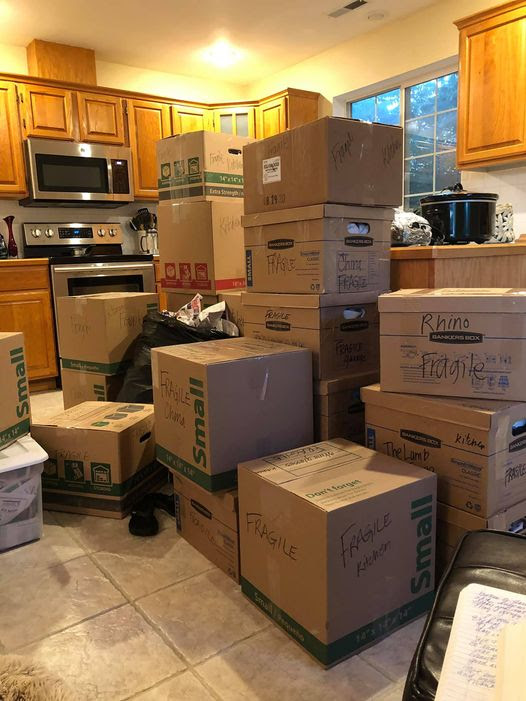
My Facebook memories have been about the move from Grandview to Tri-Cities that we made September 3, 2019. I’m still amazed at all the stuff we had accumulated in the nineteen years that we lived in Grandview. Even though we only lived in the Sherilyn Ct. house for 15 years, I say nineteen, because I don’t think we ever unpacked all the stuff we had when we moved to Grandview in 2000.
I can’t remember how many big garbage bags of stuff I took to Goodwill in the move to Tri-Cities; two boxes of books, 25 musical cds, miscellaneous nicknacks, some guitar shaped sunglasses (Lord knows where those came from,) six big bags of clothes and shoes…mine. The shoes were high-heeled shoes that I loved, but couldn’t wear anymore because wearing them was painful. They had been in my closet for years.
Packing and purging brought some great memories. I’m not gonna lie, it was emotional at times. I found a sweater that Mom wore. It was old…still had the shoulder pads…and was all balled up. I held it up close to my face, tried to put it in the Goodwill bag and then the good-memory tears fell. Nope, could not let go of that. All of the refrigerator art the kids made went with us, too. Dennis kept a sweater that his mom made for him 50 years ago, even though he never wore it. It was fascinating to see what went with us and what got left at Goodwill. It’s kinda like our belief systems. Those memories and beliefs that hold us back need to go. Those negative beliefs can still write the script for our lives if we aren’t careful. “I can’t do this because I’m too old, too young, too fat, too skinny, I failed there before, I have no clue how I could, I don’t have enough money or” geesh, you fill in the blank.
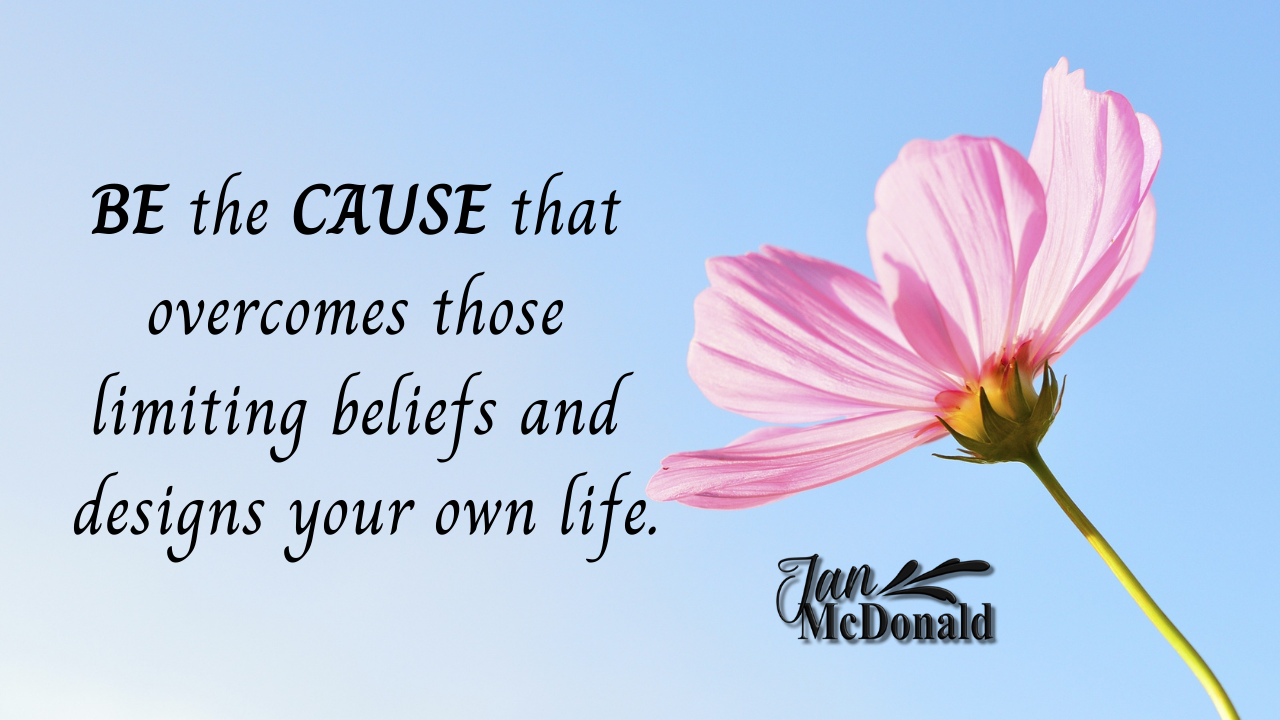
Instead of “I can’t, because,” how about you BE the CAUSE that overcomes those limiting beliefs and designs your own life? How about you BE CAUSATIVE and pack those defeatist attitudes up in a big black garbage bag and haul them out to the curb for the trash man. Go back, rewrite those gloomy memories so they serve you. Learn from them because you’re not that person any more. You probably would do it differently and better as the person you are now. You bet I would be a sober and better parent if I understood then what I do now.
If the memory or event is a secret something that someone has done to you that has had a terrible impact, find a trusted friend or coach and tell them about it. Shame and/or guilt loves to be kept secret, and they both are dispelled when brought out into the open. I’ve experienced tremendous emotional freedom handling my past this way.
Remember, where our focus goes, there our energy flows. When we think about our past, let’s direct the most energy on our great achievements and warm memories. But most of all, let’s center our attention on our goals, dreams and those desires that might be in our future. That’s the kind of emotional energy that propels us forward,
"Until we deal with our "head trash" nothing is going to change."
--Jan McDonald
Can you believe it’s almost September? What happened to this year? It’s the last quarter of 2021 and how are we doing with our goal achievement? I’ve been reflecting on the progress that I’m making toward my goals. I’m closer to achieving them, but it’s about those competing commitments. I’m not talking about things that cause setbacks that I can’t control. Let me explain.
There’s reasons why we don’t get our goals accomplished or make the progress we want. What normally happens is we define these things as reasons, the truth is they’re excuses. (Ouch!) Excuses are competing commitments. Let me give you an example.
I looked back on my year and made excuses that I was really busy, or I needed to spend time with my husband, or I didn’t know how to move forward….blah, blah, blah. When I really thought about it–all of those things were excuses–or competing commitments.
Maybe we really want or need to lose some weight, but tomorrow our friend is having a backyard barbeque. We can’t start until after that, so we’re going to eat ice cream tonight. Besides, think of all the great food we would miss tomorrow. Those outside excuses compete with our inner desired commitments. Some of those excuses are just head trash. We choose to let outside circumstances and conditions derail us.
Choice happens in our minds.
For sure, there will always be competing commitments. Some of them will be the same excuses we’ve had in the past. At least that’s what I found in my reflection time. Some of the things that are going to stop us from progressing toward our goals are predictable. We know in advance that there’s going to be more pot lucks and barbeques. We know in advance that we’re going to have days that are extremely busy. Our car battery may die. Then, of course, there’s football. Yes, I’m finishing email this during half-time.
I know that it’s easy for me to tell myself that I can do anything tomorrow if I am not up against a deadline. Most of the time, I’m pretty focused, but honestly, I can choose more fun things to do than work sometimes. What are we going to do when these competing commitments arise?
We can’t make the decision to lose weight at the barbeque standing in front of the table of brownies, potato salad and chips. We can’t make the decision to go to the gym at 5:00 in the morning when it’s cold and raining. Let’s decide in advance what we’re going to do when competing commitments arise.
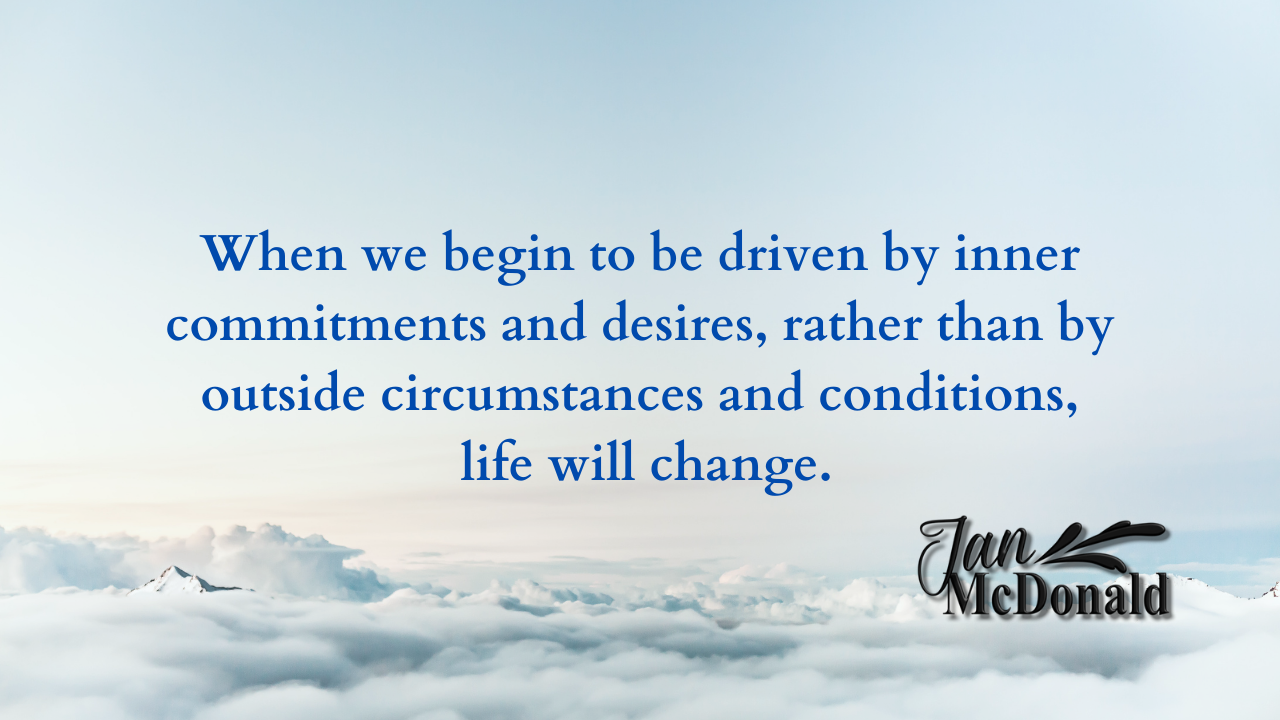
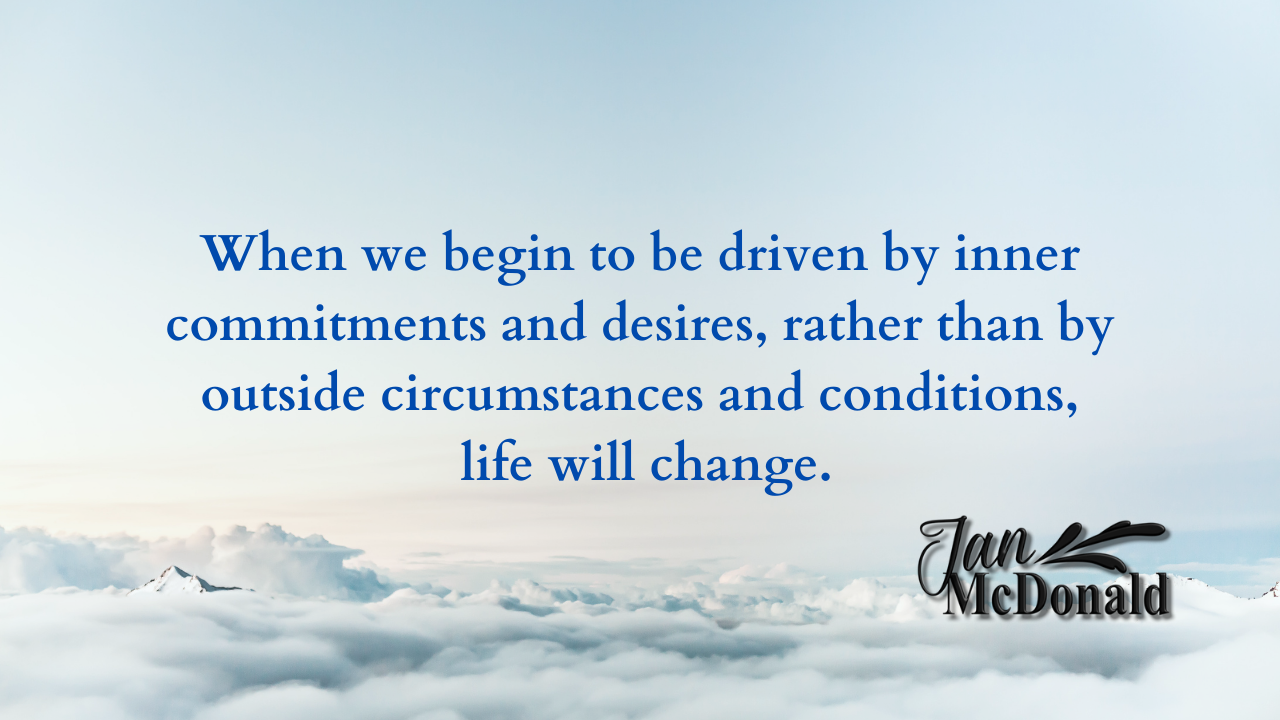
When we begin to be driven by inner commitments and desires, rather than by outside circumstances and conditions, life will change. We’ll progress forward toward the goals to which we have committed. We have to remove the head trash; those defeating thoughts that keep us from our desired lives. We have to come up with a “move forward at any cost” contingency plan when we’re faced with a circumstance that competes with our desires and goals.
One of my contingency plans that came out of my reflection time is to focus on my desired life rather than instant gratification. I kick my head trash to the curb and picture in my mind who I will become or what I will achieve by doing the thing that is my inner commitment. It’s a great plan that works for me. Yes, it takes mental discipline, but that’s a topic for another email.
How are you going to win when an competing commitment threatens to derail your goals?
"...there was a noise, a rattling sound and the bones came together, bone to bone...and breath entered them; they came to life and stood up on their feet."
--Ezekiel 37:7, 10 The Bible
On my way to hike Badger Mountain the other day, I heard the song by Elevation Worship, “Dry Bones Rattle.” As I walked to the top, I couldn’t help but ponder over the words. This email was a Facebook post, but I’ve been thinking about this all week. I don’t write many emails that are Christian-faith themed, but this is one….
The words in quotations are from the song:
“Friday’s disappointment was Sunday’s empty tomb, since when has impossible ever stopped You?”
Could life ever get crazier? There are so many events that could steal our joy…if we let it. So many distractions and unknowns on which we can focus. So many things out of our control.
If I focus on the negative, that’s not only what grows in my life, but it’s what I attract. AND if my thoughts are gloomy, I want to isolate, too. I don’t want to be around anyone else. Really, who would want to be with me when I was feeling like dry bones? Haven’t we all been in an isolated desert enough these last months?
The song comes from this Bible story: The Lord and the prophet Ezekiel were sitting in the middle of a desert valley full of a great many dry bones. (Ezekiel 37 You gotta read the story!)
The Lord says, “Hey, Zeke (okay not his exact words), can these bones live?”
Zeke replies, “O Lord, you alone know.”
As I hiked, I thought to myself, “where in my life am I like dry bones? What part of my life has been parched and bleached like dry bones in the desert?” I’m like dry bones when I focus on things that are not mine to control…when I give power in my mind to things and people that I am powerless over. Ouch. When I focus on the negative I am like dry bones in the desert. The Lord told Ezekiel how to make the dry bones come to life by speaking life into them…and the rattle began…dry bones began to come to life…again.
Back to the song: “Praise makes the dead man walk again.” Beholding the beauty of Badger Mountain and the valley below caused gratefulness to well up inside me. It felt like rain in my desert. I have so many blessings in my life! Praising and thanking God for these blessings always lifts me up.
“Open the grave, I’m comin’ out! I’m going to live again.”
What about you? Do you have some dry bone places in your life? Is your past holding you hostage? Is your prayer life off? Do you feel inadequate, lacking The Power? Do unknowns cause tornado stomach? (Oh wait…that was me.) Do you feel like you’re in a tomb of negative thinking?
“You’re not gonna run out of miracles anytime soon.”
God’s not running out of miracles. We need to expect His miracles. Look for them. What is your needed miracle? What would your life look like if you got that miracle? Create that vision in your mind and think on that. Think on the positive and praise God for what you do have. “Praise makes the dead man walk again.”
Do you hear it? Open the grave and come on out. Dry bones rattling and coming to life. LIVE again! Really LIVE again! You have The Power within you! “Resurrection Power runs in my veins, too. I believe there’s another miracle in this room.” If you want to hear the song “Rattle”, click here:
"Nothing is either good or bad, but thinking makes it so."
--Shakespeare
I’ve been reading (very slowly this time) through a book by Wayne Dyer, “The Power Of Intention.” I’ve been writing about peace and leadership and how that is supposed to look, so I don’t think it’s any coincidence that I “stumbled” on this chapter about living a stress-free life.
Wayne Dyer says that we were created to live fully alive and on purpose in a state of peace and joy. I happen to agree with him. Many of you know that I believe in God and He isn’t anything like I thought He was. Until I got to know Him, I thought he was this big guy who lived in heaven and really needed some anger management classes. He is nothing like that at all. If you don’t believe in God, just ignore this part, but He sent Jesus so that we could live life abundantly. We can have abundant joy, peace, blessings and happiness.
God is love, so everything that He does with us stems out of His love for us. He wants us to love Him back out of our own volition. We are not robots, He has given us choice. He has given us the power to choose our thoughts. That is why I thought this chapter was so powerful.
Whether you believe in God or not, you have the power to choose your thoughts.
Back to Wayne Dyer’s book. In this chapter, he writes, “There’s no actual stress or anxiety in the world, it’s your thoughts that create these false beliefs. There are only people engaged in stressful thinking.” Read that sentence again and ponder it.
You may be wondering about all the bad that is transpiring in the world, like murder, rape, abuse and Coronavirus. What about that? I don’t want to negate the awfulness of some things that have happened or can happen to us. BUT, let’s talk about our everyday normal life.
Think about the things that make you anxious. Stop and think about them.
I’ll give you a personal example. Up until recently, when I had a workshop or speaking engagement in my calendar, I couldn’t sleep well for a couple nights prior. It didn’t matter how much I prepared or how well I thought the presentation was written, sleep eluded me. What the heck? What was this all about?
I reflected on it and came to the insight that it was about ego. I wanted to look good. I was afraid of failing. What if I do something stupid? What if they don’t have fun? What if they don’t think the time spent with me was worth it? What if…what if…okay, what if? If I have done my best, I have no control over their response. Although, I really like to think I do:) If I do something stupid, I can laugh with them. It won’t be the first time. I found that it was all about me. And THAT is hilarious, because I am not presenting for me, I am there to serve them and to add value to THEIR life. Geesh. Our natural state is tranquility and peace, but when we try to control those things that we have no control over, or think stressful thoughts, that’s what causes the anxiety.
The cure? Consider Rule #6.
“Two prime ministers are sitting in a room discussing affairs of state. Suddenly a man bursts in, apoplectic with fury, shouting and stamping and banging his fist on the desk. The resident prime minister admonishes him: “Peter,” he says, “kindly remember Rule Number 6,” whereupon Peter is instantly restored to complete calm, apologizes, and withdraws. The politicians return to their conversation, only to be interrupted yet again twenty minutes later by a hysterical woman gesticulating wildly, her hair flying. Again the intruder is greeted with the words: “Marie, please remember Rule Number 6.” Complete calm descends once more, and she too withdraws with a bow and an apology. When the scene is repeated for the third time, the visiting prime minister addresses his colleague: “My dear friend, I’ve seen many things in my life, but never anything as remarkable as this. Would you be willing to share with me the secret of Rule Number 6?”
“Very simple,” replies the resident prime minister. “Rule Number 6 is ‘Don’t take yourself so g—damn seriously.”
“Ah,” says his visitor, “that is a fine rule.” After a moment of pondering, he inquires, “And what, may I ask, are the other rules?”
“There aren’t any.” (This is from a book called “The Art of Possibility,” by The Zanders)
When you feel anxious or stressed this week, consider your thoughts. How are you thinking about the issue that is stressing you? Is it in your control? Is there a different way you think about it?
“The illiterate of the future are not those who can’t read or write, but those who can’t learn, unlearn and relearn.”
--Alvin Toffler, “Future Shock”
Most of us know exactly what we should be doing with our time, and our lives. Despite that, sometimes we just don’t do it. Why is that?
When we think of what prevents people from doing what they know, we have to look at their learning models, as humans. We all operate through learned models. Some operate through learning models of achievement and some operate through learning models of failure. Either way, they are learning models. There’s 3 components to a learning model;
1. Awareness
2. Belief
3. Understanding and applying the principles and skillsets
We see this all the time in students when they prepare for the SAT test. They take the classes, learn the skills and then blow the test. We say they are bad test takers, when in actuality, they have reached their own level of belief. They aren’t sure they can perform well on the test.
We never outperform our belief level. Until our belief level about who we are and what we can do changes, we can be skilled as all get out, but we don’t export that skill.
The third part of this is understanding and applying the skillsets. Most people don’t perform their past behavior because they never get past their level of belief. At some point in the six-year-old’s life, the desire to ride overcomes every fear, doubt and worry he has about riding. He watches the others and pictures himself there with them. Someone shows up to show him, to teach him balance and encourage him. The child doesn’t even care if he is ridiculed for falling because his vision of himself riding a bike has expanded beyond his fear of failure. When he falls, he gets back up and continually tries. Eventually, he succeeds!!
This is exactly how we turn learning models of failure into learning models of success. Once we become aware of a new desire to be, do or have more, we explore our beliefs. Yes, we may not be experienced in this new desire. It might be true that we don’t have a clue on how to achieve this new desire or goal.
I don’t know who said this, but I believe it, because I have lived it.
“If the dream is big enough, the facts don’t count.”
To change my learning model, my experience has been to build an image within my mind that’s an entirely new image. Then I begin living the new image I want AS IF I already am the new image that I want to express. It’s interesting how people, opportunities and ideas show up to help me understand and apply the principles in the new model that I envision. With practice, time and belief, I can build this new image on the outside. It’s just like learning to ride a bike!
I hope this makes sense. In the fall, be on the lookout for an opportunity to discover learning models of success in your life. My desire is help those individuals who feel stuck with learning models and belief systems that aren’t serving them. There will be more details to come in the next couple of emails.
In the meantime, explore some of your learning models. Why do you not do what you know you should do? If you have questions, shoot me an email. Don’t beat yourself up, just become aware of where you want change. Think about who you want to become, what you want to do or have and know that it’s possible.
“You don't have to be amazing to start, but you have to start to be amazing."
--A commercial during the Olympics
I just got back from a difficult, birthday hike on Badger Mountain. I experienced an incredible amount of gratefulness as I reflected on my life. I’m healthy and fit; I love my calling as a coach/trainer/consultant; I live in a gorgeous area; I get to live in America; I have an amazing family–the list could go on.
I remembered my most amazing fitness feat before I decided to get healthy was getting from the couch to the refrigerator to get wine, beer, tequila….
Before I quit drinking and drugging–I had every excuse; “I don’t have a problem.” “I’m too young to quit.” “I don’t think I can or want to.” “How will I be able to have any fun?” “I’m afraid, because I’ve tried so many times and failed.”
I was getting ready to get ready to live my life in a totally different way.
Many people get ready to get ready. Maybe you would like to learn to play the piano. You research teachers in your area and maybe even call around for schedules but then you stop short of setting up your first session. Why is this? Why is it so hard to get started? It’s very simple. Fear.
Fear is a debilitating emotion that can keep you from reaching your full potential. We all have fears and many of us have learned that until we conquer our fears, we are stuck. We can’t start that project or that goal or achieve that which we so desire.
How do we start when we are scared stiff? Instead of working on the fear, let’s try a different approach and let’s look at the end result. Using the piano example, maybe this has been a dream all your life to learn but you never had the chance; circumstances got in the way. And now you have the time and you have the means to get the lessons but you are afraid. What if you stink at it? What if you are too old to learn? What if you can’t master the keys and the chords? So what! So what! You will never know unless you try. And try more than once, because failing is part of succeeding.
I failed many times at recovery. It took me years to get ready. When I finally embraced and fearfully stepped into my vision of clean, sober and healthy Jan, I was able to move in the direction of that vision–one day at a time.
Think about your vision, your dream of playing that concerto piece you love so much. Or playing that Billy Joel song. Whatever your vision is of learning to play the piano – that is what you need to focus on every day. Every time you get scared, every time you doubt yourself, see yourself at your first recital playing a piece you practiced for hours and hours, day after day and now you are ready to play for a group. Imagine yourself experiencing the enjoyment of reading the music sheet and then turning the notes into actual music – pouring out of the piano – imagine how that would feel.
Now is the time to start. No more excuses.
Jan
Jan McDonald The John Maxwell Team
To subscribe, click here: https://www.jan-mcdonald.com/email
“The intensity of the pain depends on the degree of resistance to the present moment.”
--Eckhart Tolle (author of "The Power of Now")
I finally found my 2018 journal. I’d been searching for a couple of months. When I pulled out all of my supplies to facilitate an in-person workshop…there it was! As I was reading through it, I realized I’d spent alot of time trying to control events, people and things in my life that weren’t mine to control. When we long for things to be the way we want them to be, rather than the way they are, that’s resistance. Hmmm…control=resistance.
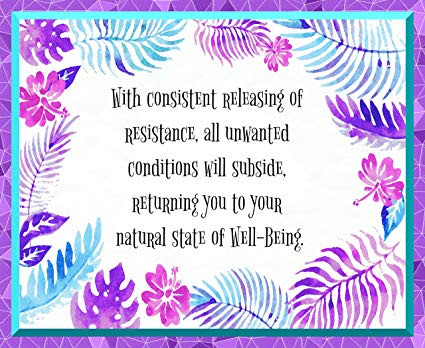
The Universal Law of Resistance says that what we resist continues to appear in our experience until we learn to release what created the resistance in the first place. It’s like we get to keep taking the test until we get it right.
Whenever we experience discontent, unhappiness, or bad attitude, there is something we are resisting. It’s not the experience that itself that causes pain, it’s the resistance. You may want to read that last sentence twice. This “pain” is because we label our emotions as good or bad. They are not either, until our mind says so. Emotions are just energy in motion. All feelings come and go, so why pay so much attention to whatever shows up in any particular moment? If you think I’ve gone off the deep end here…remember the last time you had a fight with your hubby, you overdrew your checking account, you had a crucial conversation that went bad, or some other crisis…and then you had to go to work? You pulled yourself up out of your fetal position, changed your attitude and went to work, didn’t you? AND as a leader, nobody had a clue what you had been through.
When you got home from work that night, the earlier crisis didn’t seem so bad after all. E-Motion. Energy in motion. Those tough feelings came and went. The situation may not have been resolved, but the feelings were not as intense. We weren’t giving those emotions energy because we were working.
How do we deal with resistance? First we need to become aware of what it is that we are resisting. Then we need to let it be. Don’t try to fix or change it, just become aware of our inner chatter about it. What are we saying inside? What is the feeling and why? Don’t fight it and don’t stuff it either. Acknowledge it, surrender it and say “yes” to the experience/feeling. Be grateful for your awareness.
Yes, easier said than done and it takes practice. My experience has been that this works, because where my focus goes there my energy flows. If I am busily focusing on the negative, it calls more negative into my life. If I let go and surrender what I’m resisting, the tension drains out of my neck and those negative e-motions float away.
It’s good to know that growth is a process…well, I’m happy with that fact most of the time…because there are still places in my life where I’m still taking that test. I’ve grown, though, because more times than not, I am able to open my grasping, little hands and let go of what is not mine to control.
"Grant that I may not so much seek to be understood as to understand."
--Francis of Assisi
Are Dennis and I the only couple that speaks, okay, yells at each other from different parts of our home? Do we take the time and the interest to actually want to know the answer to this question when we see someone in the grocery store, “How are you doing?” When was the last time you were misunderstood? Or when has someone told you something and you didn’t hear? When was the last time you asked a question and when the other person answered, they were looking at their cell phone the whole time?
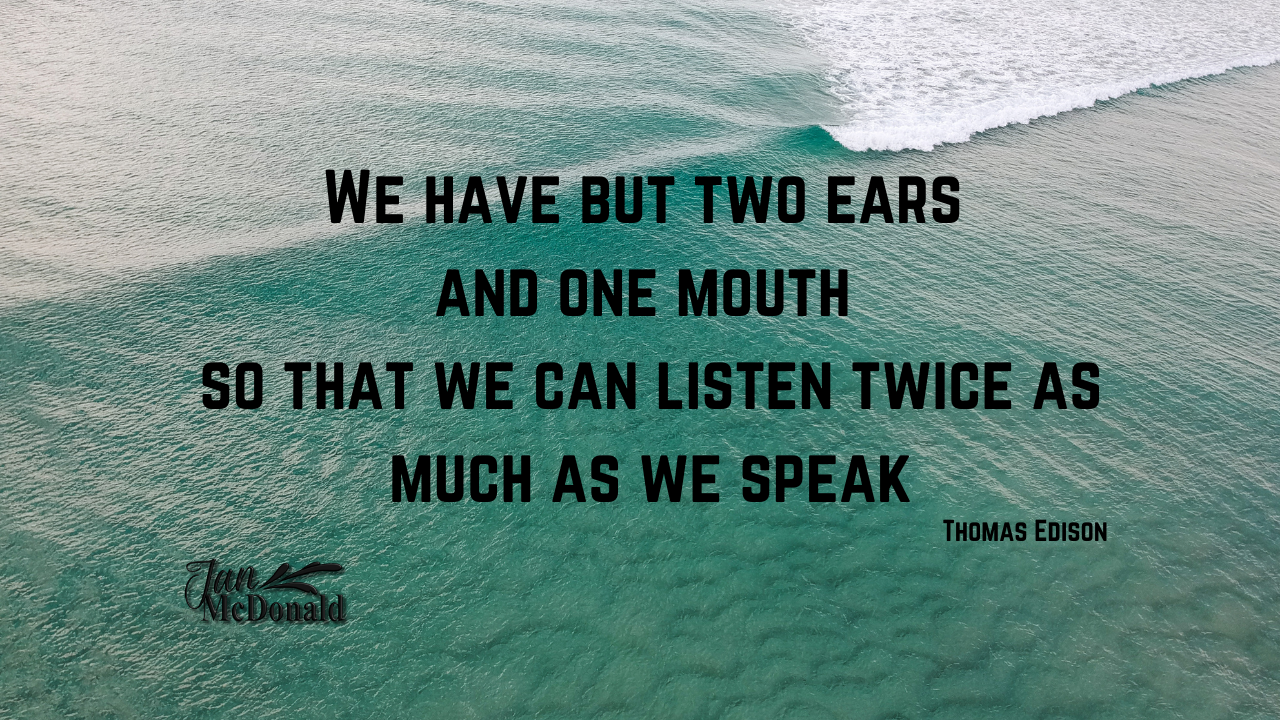
I don’t remember where I read this, but in one of John Maxwell’s books, he says that the best gift we can give, the best way we can add value to another, is to listen to them. When was the last time someone actually listened to hear what you were saying…they weren’t thinking about how they were going to reply? Did they seem really interested in what you were saying? Ouch. I have to confess that when I am in the middle of a task, my listening skills can fly right out the window. Oh yeah, how about those times in a conversation where I just know that I’m right and then have to prove it. Or I perceive that someone is taking way too long to finish their thought and I interrupt and finish it for them. OOOOOKAAAAYYY. Let’s look at some ways that we can add value to others by giving them the gift of listening.
1. First, put down our cell phones, close our computers, turn off the television and shut the iPad. Give the other person the gift of our full attention. When I am in the middle of something, I have learned that I need to ask the person if they can wait a moment until I finish what I’m doing. If I don’t, I will still be thinking about my task and won’t be focused on what they are saying.
2. Maintain eye contact–that prevents us drifting out of the conversation.
3. Refrain from judging. Judging prevents clarity in hearing their thoughts and we expend our energy forming an opinion rather than really hearing. Slipping into judger mode or becoming defensive causes the fight or flight response in our body. You know what that does…all the blood drains out of our brains into our extremities so we can flee the situation or put up our dukes. How good is our listening or even our thinking when that happens?
4. After the other person has spoken, repeat back to them in the form of a rephrase. These recapping statements are tentatively spoken. We can start with, “I heard you say,” or “Did I hear this right?” Then rephrase or recap what you heard. This gives them the opportunity to elaborate in the case that we heard incorrectly, or they weren’t clear in their sharing.
5. Be curious. Listen for the words behind the words. Seek to understand the full meaning of what they’re saying, and by all means, don’t interrupt or finish their sentences.
When someone listens to me with their full attention, I feel appreciated, cared for and valued. I think I may have written this for me, but I hope you’re getting some value, as well. Big smiley face here. You always know where I’m struggling from these emails…or what I’m teaching on the next week:) Challenge yourself this week to listen like this…give the gift of your full attention.
I bet you have other suggestions to add to my list. Please email me if you do!
The 4th of July sounded like a war zone here because there were so many fireworks exploding. I saw a facebook post that said, “Fireworks on sale; Buy One Get 56,000.” It sure sounded like that.
Normally, on July 4th and New Year’s Eve, my dog, Truffle, paces the house looking for a safe space, trembling at the sound of fireworks. It’s awful to watch because I am powerless to alleviate her fears (and you know how I feel about being powerless.) My best friend was staying with us on the fourth and suggested I turn on the fan in the bathroom so Truffle couldn’t hear the noise. Truffle was already cowering in the bathroom, so I gave her a peanut butter CBD treat, wrapped her in her thundercoat, grabbed a small fan from my office because that fan wasn’t as loud. Then we hunkered down for the evening.
The fan, the CBD, the thundercoat and me hanging out with her worked. After a while, she fell asleep. I left her at midnight to go to bed because the fireworks subsided. She came out with her tail wagging, saw me in bed, and then headed back to her safe space to sleep the night away.
Truffle is 9 years old. All of these years, suffering through fireworks and never experiencing harm, you would think she wouldn’t feel afraid. It’s interesting, though–I think I’m a bit like Truffle sometimes. How many times have I been anxious about something that never happened? How many times have I been hunkered down on the bathroom floor rather than make a phone call to a prospect? How many times have I not had (what I assumed was) a crucial conversation because I feared the outcome–it wasn’t a tough conversation after all? And I have procrastinated a project because I didn’t know how to do it and feared I would do it incorrectly. Or is it just me that likes a safe space?
In Hawaii last year, our resort had this long, corkscrew tube slide into one of the swimming pools. “Mom, we have to do that!” my daughter said excitedly. Are you kidding? It would be dark, I couldn’t see where I was going or where it would spit me out. That powerless thing again. Crap…I couldn’t let Julie know I was afraid. Fine. I dreaded every moment of the stair climb to the top. The guy sitting at the top said, “I’m here to make sure you go down feet first.” OMGeeee, people want to go down head first? I just laughed.
IT WAS A BLAST! I can’t count the number of times that we enjoyed that slide!
I know these sound like minor things, but fear can be paralyzing and prevent us from achieving our goals and dreams. I have coached individuals who didn’t set goals because they were afraid of not attaining them. Fear of success can cause us to sabotage the very achievements that we have so hoped to earn. What does fear cost us? It’s a great question, isn’t it?
My experience in overcoming fear is to take action…one baby step at a time. Eleanor Roosevelt says it best, “You gain strength, courage and confidence by every experience in which you really stop to look fear in the face. You are able to say to yourself, ‘I have lived through this horror. I can take the next thing that comes along.’ You must do the thing you think you cannot do.” That action makes the next scary thing easier to do.
“Press on: nothing in the world can take the place of perseverance. Talent will not; nothing is more common than unsuccessful men with talent. Genius will not; unrewarded genius is almost a proverb. Education will not; the world is full of educated derelicts. Persistence and determination alone are omnipotent."
--Calvin Coolidge
A couple of nights ago I was reading the chapter on Persistence again in “Think and Grow Rich,” by Napolean Hill. I was reminded of mile 10 in the Big Sur marathon. It’s a 5% grade uphill to Hurricane point. Having driven the course the night before, I knew that hill was more than a mile long. It looks really steep at the bottom, believe me. I took a deep breath, focused on the road directly in front of me and just ground it out to the top. That success gave me the impetus to finish strong. I knew if I could run up that–I could run anything.
Sometimes leadership feels like that doesn’t it? Whether you’re the CEO of a large corporation or non-profit or the parent of a family, sometimes we just have to put our head down and face what’s directly in front of us…one step at a time…until we reach our goal.
Persistence is a driving trait of a strong leader. It is the ability to continue to move forward toward our goals in spite of tremendous obstacles or set backs. Persistence helps us confront complications and yet still keep our perspective.
When we face obstacles, challenges or even failure, persistence is the ability to face them with the determination and tenacity to find a solution. As leaders, we are the ones who set the tone for those we lead. Isn’t this the behavior that we want to see in those we lead? If we are raising up other leaders, we want them to learn to persist until they solve the problem. Our persistence establishes a set of expectations for our teams. They learn to expect to solve problems on their own and they develop a “can do” attitude because of that expectation.
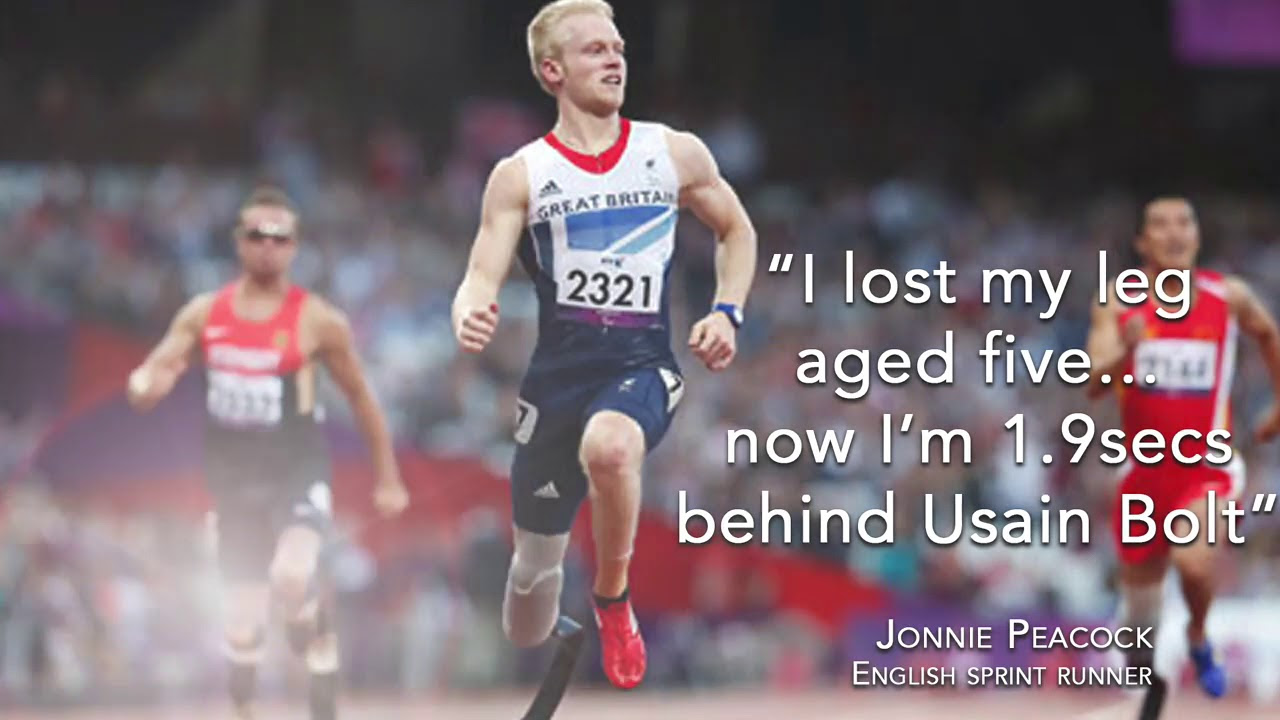
We are programmed to give up or take the easier route. But grinding out the best solution builds character and helps grow into our full potential. Persevering develops our talent and self-esteem for the next challenge that we face. It makes us stronger, hence it makes those we lead stronger.
Life may be easy…but that’s only if we are living inside of our comfort zone.
Who wants to stay there? It’s not very fun or exciting. Leaders live on the edge. Leaders push the envelope …most of the time. Yes, there are times, when I want the couch and my blankie–but those times don’t last long anymore. Practicing persistence can become a habit, because of the positive effects it has on us and other in our lives.
Persistence gives us the ability to remain consistent even in the face of challenges and difficulties. Consistency provides stability to those who follow because they know what they can expect from the leader and they know what is expected from them.
The last thought on persistence; Those who develop the habit of persistence seem to enjoy insurance against failure. No matter how many times we may be defeated, persistence enables us to get up and give it another go. No matter how smart, educated or talented we are, a goal or vision of any great stature will not be achieved without persistence. Nothing takes the place of persistence.
Have you developed the habit of persistence? Are you modeling that for those you lead?
"Personal development is the belief that you are worth the effort, time and energy needed to develop yourself."
--Denis Waitley
Dr. Ben Carson’s story is so inspiring. His mom, Sonya, didn’t have any more than a 3rd grade education. She married his dad, a preacher, because she figured it was the only way to get anywhere. Sonya found him unfaithful and moved to Detroit with Ben and his brother to raise them as a single mom.
She believed in herself and her sons enough and went to work to provide the best that she could for them. She worked as a domestic servant and at one time had three jobs so that she could provide for Ben and his brother, Curtis. They didn’t see much of her at times, as she would go to work before they arose and come home after they went to bed.
Ben was at the bottom of his class and was laughed at by his peers. He developed a severe anger issue because of it. He almost stabbed a student one day in a disagreement over radio stations. The only thing that saved him was the knife broke off in the belt of the student he attacked. Sonya believed she could turn his life around She made Ben and Curtis two library books per week and make reports on them. Even though Sonya could barely read, she would look over the reports slowly, and then put a check mark on top of the page.
The boys hated the strict regimen of first doing homework and reading before they could go out to play. But later, Ben realized that he could transport himself out of Detroit by reading a book. Through this, Ben began to see value in himself and then continued to add value to himself. And the rest is history. He had a childhood dream of becoming a doctor. He not only became a doctor, but a world renown and very gifted neurosurgeon. He has added tremendous value to others.
Zig Ziglar, a motivational speaker, says “It’s impossible to consistently behave in a manner inconsistent with how we see ourselves.” We can do very few things in a positive way if we feel negative about ourselves. Low self-esteem is the lid on our potential. Your self-esteem deficiency will put limits on you. Steps to Build your Self-image
1. Guard your self-talk. Whether you know it or not, you have a running conversation with yourself all day long. AND WE LISTEN TO OURSELVES. Not only that, but I am sure that there are some limiting beliefs that were given to you accidentally that talk to you, as well. We can’t change the way we think about ourselves until we change the way we talk to ourselves. What we say about ourselves, we tend to believe. What we believe, we tend to act. What we act, we tend to become. No world record was ever set by anyone who said “I can’t do this.”
The damage that we do to ourselves with our self talk is way worse than what others say to us.
2. Stop comparing yourself to others. You do either of two things when you compare yourself to others. Either you perceive the other person to be far better, thinner, handsomer smarter than you and become discouraged, or you perceive yourself better than others and become proud.
3. Move beyond your limiting beliefs. • Take some time (right now) to identify a belief that limits you. (if you need help with this, let me know.) • Determine how the belief limits you. • Decide how you want to act, feel, or be instead of that belief. • Create a new turnaround statement that gives you permission to be this way. Read it daily. 4. Add value to others. It’s hard to feel bad about yourself when you’re serving others.
5. Practice a small discipline daily in a specific area of your life. Since your self-worth is based on the positive habits, actions and decisions you practice every day, why not chip away at your biggest problems daily.
What can you do every day that moves you closer to being the person you want to become? Do the right thing, even if it’s hard.
Take a couple of minutes and write one thing that you are going to implement this week to grow your self-esteem positively.
Then celebrate the victories, no matter how small.
Stand tall! There isn’t anyone else like you!
Jan
Jan McDonald The John Maxwell Team
(this information came from John C. Maxwell, The Law of the Mirror)
"I wish there was a way to know you were in the good old days before you actually left them."
--The Office
While on vacation, I was riding with my son in his pickup truck and a song came on the radio by a group named Leftover Salmon (I know, I didn’t believe it either) titled “Brand New Good Old Days.” Here are the lyrics to this catchy bluegrass tune:
These days, I seem to do alot of dreaming, I’ve forgotten all my scheming–just trying to be in the here and now. These days, full of ever more distraction, I can find my satisfaction in the faces of my good friends all around.
The refrain goes like this: These are the brand new good old days. My “used to was” got stuck way back in yesterday. It’s never more now than it is today. These are the brand new good old days.
Next verse: These days, I won’t be getting any younger and before time takes us under, I’m living every moment of every day. These days, I don’t think about tomorrow because time just can’t be borrowed–today just turned to yesterday.
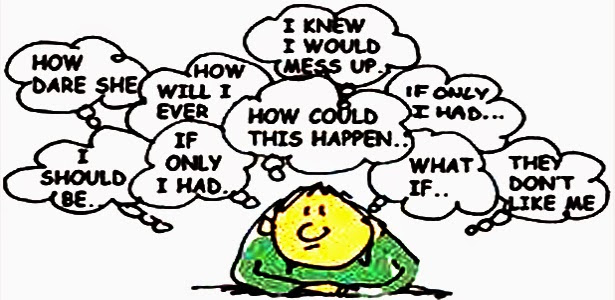
How much time do we waste wishing that life was like it was before? Or is it just me? Oh I shoulda I wished I woulda if only I could redo that then I coulda I would be and then…Stop, because yesterday ended last night. And tomorrow is not guaranteed. May we just take a moment this Memorial Day weekend (I’m writing this on Friday) and be present? Let’s go sit somewhere, turn off our digital devices and be grateful for the here and now. These are the brand new good old days…the ones we’ll be pining for in the future. Let’s make the most of them.
Just in case you want to hear the song: https://youtu.be/4dOAHtkPark Be careful, it’s one of those songs that will stay in your head for awhile:) Enjoy!
"Never let your limiting beliefs, your stuff or people define you. Only you are given the gift to do that."
--Me
In my travels this week, I have learned that many of us are not totally experiencing the freedom that we desire. We’re walking around happily on the outside, but dragging an invisible Ball And Chain (BAC) that is holding us back. Whatever is holding us back owns us.
The definition of the word “own” is to possess; belonging to oneself or itself; to have power or mastery over; to acknowedge as to be true, valid or as claimed.
In “The15 Invaluable Laws of Growth,” John Maxwell shares that stuff can own us. As a culture, many have become “enslaved by the desire to acquire.” It’s one of the reasons why we live month to month. We have bought so much on credit, that before we pay it off, that item is out of style or not working anymore. We never end up owning the stuff, it owns us. The credit card debt becomes a ball and chain. Many buy this stuff to keep up with the Joneses, or to fill an emotional or spiritual void in their lives. Retail therapy used to be one of my drugs of choice until I met Dave Ramsey.
Another BAC that owns people is the fear of what other people think. I felt this personally (I know! Who woulda thought that?) when I felt resistence to becoming involved in a small group. What was the resistance I was feeling? What was I afraid of? I sat in those questions for a couple of days so I could answer them. I came to the conclusion that I was struggling with my own worthiness because I was not “The CEO” anymore. What was my value that I didn’t have that title? What did people think of me? And the big one, did I really want to be transparent about my feelings of inadequacy? I mean, really, how was that going to look on this confident, powerful persona? (Smiley face here.) Which brings me to another BAC that I have found many are owned by–limiting beliefs. Like mine above. That limiting belief made me want to hide my God-given talents and gifts to protect myself from my PERCEIVED rejection of others. That’s what I like to call MSU–making stuff up, or making stories up. We make up our own stories to protect ourselves from failure or pain and they hold us back from freely sharing our brilliance and strengths. These beliefs own us and keep us stuck. What’s interesting is that many times we aren’t even aware that we are holding back!
Here’s the last ball and chain for this email–I’m sure there are more. We actually accept the lousy stuff that other people say or we think they say about us, as truth. Unless it’s your wife–husbands never believe their wives. Ask Dennis. We give this BS (Belief System) our full attention rather than focus on what’s true and really fabulous about us.
What’s true about you (and the rest of us) is that you were created perfectly in the the image of The Creator. He thought long and hard about you. He gave you special gifts and talents for you to bestow generously onto others. There is a purpose for you on this earth that nobody else can fulfill. It’s been scientifically proven that nobody else has your DNA. Go ahead and own this paragraph!
We’ve given the BAC keys to the stuff, the beliefs and the people that we allow to imprison us. How do we get the keys back to unshackle ourselves? The next time you feel resistence, fear, doubt or “not enough,” ask yourself why you feel that way. Stay in the question until you find the answer. Trust me, you’ll find the answer. That awareness will allow you to take steps to re-focus your attention on your truth. It’s the truth that sets you free.
That has to be one of my favorite quotes these last 18 months–along with the one that says we can make lemonade out of the lemons that we are given. 2020 was definitely the year of the lemon. Living on the other side of “yes,” believing and creating solutions for challenges that I thought were impossible, resulted in some sweet lemonade. Okay, not always, but thinking creatively prevented negative thinking.
When you get this email, I’ll be with my kids and grandkids, probably boating, hiking and just generally enjoying their company. I thought you would enjoy this story while I’m gone:
In a small Italian town, hundreds of years ago, a small business owner owed a large sum of money to a loan-shark. The loan-shark was a very old, unattractive looking guy that just so happened to fancy the business owner’s daughter. He decided to offer the businessman a deal that would completely wipe out the debt he owed him. However, the catch was that he would only wipe out the debt if he could marry the businessman’s daughter. Needless to say, this proposal was met with a look of disgust.
The loan-shark said that he would place two pebbles into a bag, one white and one black. The daughter would then have to reach into the bag and pick out a pebble. If it was black, the debt would be wiped, but the loan-shark would then marry her. If it was white, the debt would also be wiped, but the daughter wouldn’t have to marry the loan-shark.
Standing on a pebble-strewn path in the businessman’s garden, the loan-shark bent over and picked up two pebbles. While he was picking them up, the daughter noticed that he’d picked up two black pebbles and placed them both into the bag. He then asked the daughter to reach into the bag and pick one.
The daughter naturally had three choices as to what she could have done:
1. Refuse to pick a pebble from the bag. 2. Take both pebbles out of the bag and expose the loan-shark for cheating. 3. Pick a pebble from the bag full well knowing it was black and sacrifice herself for her father’s freedom. She drew out a pebble from the bag, and before looking at it ‘accidentally’ dropped it into the midst of the other pebbles. She said to the loan-shark;
“Oh, how clumsy of me. Never mind, if you look into the bag for the one that is left, you will be able to tell which pebble I picked.”
The pebble left in the bag is obviously black, and seeing as the loan-shark didn’t want to be exposed, he had to play along as if the pebble the daughter dropped was white, and clear her father’s debt.
It’s always possible to overcome a tough situation through out of the box thinking, and not giving in to the only options you think you have to pick from.









 We are programmed to give up or take the easier route. But grinding out the best solution builds character and helps grow into our full potential. Persevering develops our talent and self-esteem for the next challenge that we face. It makes us stronger, hence it makes those we lead stronger.
 Or is it just me? Oh I shoulda I wished I woulda if only I could redo that then I coulda I would be and then…Stop, because yesterday ended last night. And tomorrow is not guaranteed. May we just take a moment this Memorial Day weekend (I’m writing this on Friday) and be present? Let’s go sit somewhere, turn off our digital devices and be grateful for the here and now. These are the brand new good old days…the ones we’ll be pining for in the future. Let’s make the most of them.