Your Path to Breakthroughs: Insights from Jan McDonald

From hopeless drunk to 30 years sober and helping hundreds of individuals and organizations unlock their ‘and then some’, I distill all the lessons gained from those transformational life experiences and share them with you in this space.

I invite you to explore these insights as way to help you breakthrough the challenges that are stopping you from becoming who you want to be.

Categories

Download the FREE Guide

5 Simple Steps to Maximize Your Effectiveness

“You don't have to do everything, even Batman had Robin.”

--Anonymous

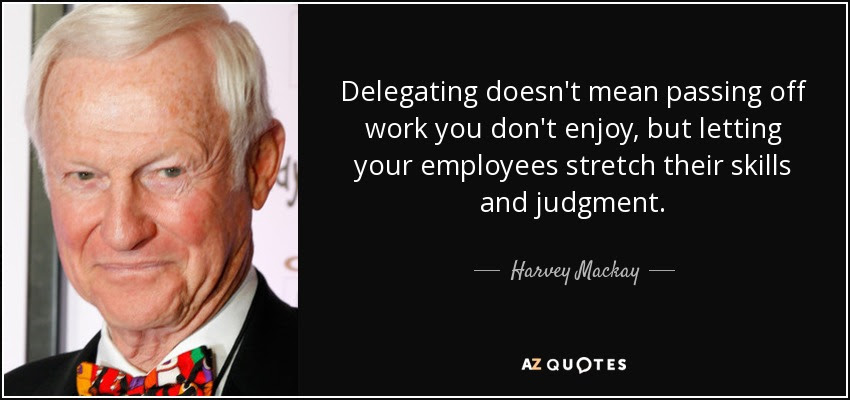
When I work with executives, delegating can be a tough concept for them to grasp.  I’ve been there. I didn’t enjoy giving up control, especially when I knew it would be faster and easier to do it myself. Besides, nobody could do it as good as I could.  Big smile here, because when I began to delegate, I found that my team members often had better ideas and better ways of doing it.

As the leader, the buck stopped with me. I enjoyed sharing in the success of a task given to someone else. However, if a mistake or there was failure, ultimately I was held accountable for it.

I found these four brilliant steps to make delegating uncomplicated in the Maxwell Daily Reader:

1. First, I do it. I learn to do the job. I need to understand the why as well as the how.

2. I do it–and you watch. I demonstrate it while you observe. I explain what I’m doing and why as you watch the process. As a task oriented person, I need to make sure that I’m detailed enough, so I ask questions to make sure you understand well. You are able to ask as many questions as you need, as well.

3. You do it–and I watch. I give you permission and authority to take over the job, but I stay with you to offer advice, correction and encouragement. This helps me to trust you with the job AND you develop trust in yourself as you complete the task with excellence.

4. You do it. Once you are proficient, I step back and let you work alone. You are drawn up to a higher level because you learn to trust yourself and I am freed up to move on to higher things.

Does this way of on the job training take time? Absolutely. But it is so worth it. When I learned to delegate in this way, my staff rose to the occasion to accomplish the tasks I had given them. Many times, these tasks were out of my strength zones but within the talents and strengths of others.  I was freed up to achieve the goals for which I was hired, like visioning, strategizing and future planning.  Delegating became a “win-win.”

And it still is!

Jan

Jan McDonald

The meaning of the word problem in the original Latin language means “to put forward.” It precedes, or comes before, a solution. I believe if we are gifted with the sight to see a problem, we will have a solution.  We could say that the putting forth of a problem is what is necessary for us to move forward into the land of solution. There is always a solution…in fact there’s usually always more than one solution. If we don’t think, “can I? ” and think, “how can I?” instead, that opens up our minds to think about opportunities!


“We cannot solve our problems with the same thinking we used when we created them.” 
                                                                                                                     –Einstein
 

We have to think differently. Problems are normally viewed as negative, but if we change our attitudes and and think about problems as possibilities and/or opportunities, everything changes.  I love this story!

An old gentleman lived alone in New Jersey . He wanted to plant his annual tomato garden, but it was very difficult work, as the ground was hard. His only son, Vincent, who used to help him, was in prison. The old man wrote a letter to his son and described his predicament:

Dear Vincent, I am feeling pretty sad because it looks like I won’t be able to plant my tomato garden this year. I’m just getting too old to be digging up a garden plot. I know if you were here my troubles would be over. I know you would be happy to dig the plot for me, like in the old days. Love, Papa

A few days later he received a letter from his son.

Dear Papa, don’t dig up that garden. That’s where the bodies are buried. Love, Vinnie

At 4 a.m. the next morning, FBI agents and local police arrived and dug up the entire area without finding any bodies. They apologized to the old man and left. That same day the old man received another letter from his son.

Dear Papa, go ahead and plant the tomatoes now. That’s the best I could do under the circumstances. Love, Vinnie 

Yep, there’s always a solution! Do you need some solutions?

Do you want to build your company culture?  
Do you want employees to get along better and understand their co-workers?  
Do you have leaders that are not really leading and you need them to?


You can find the solutions at the 1/2 day “Uplevel the Effectiveness of Your Influence” Workshop, March 30th!

Register here: https://www.jan-mcdonald.com/leadership-workshop


Finding solutions, 

Jan

Jan McDonald
Maxwell Leadership  Certified Team

"Some stories in our heads were told to us by others. Some we created ourselves."

--Me (from Self Image Mastery Class)

A woman was waiting at an airport for her hours-long flight. Since her flight was delayed, she had several hours on her hand. So, she went to the airport shops and bought a book and a bag of cookies. She sat next to a man and started to read the book she had bought.

While she was engrossed in her book, she saw that the man beside her boldly grabbed a cookie from the cookie bag. She ignored the incident to avoid a scene.

She munched some cookies from the bag and went back to her book. But the man seemed to have enjoyed the cookies way too much; he took some more cookies from the pack and started munching them.

By the passing time, she was getting increasingly irritated as the cookie thief finished her cookie stock. Every time she took a cookie from the bag, he took one. Finally, when the last cookie was left, the man nervously took that cookie and broke it in half. He offered the other half to the lady and smiled. The lady snatched the other half of the cookie from his and thought,

“this guy has some nerve that even after eating a half bag of my cookies, he didn’t show any gratitude.”


She had been so galled by the man and was relieved when her flight was called. She gathered her belongings and headed to the gate, refusing to look back at the thieving ingrate. She boarded the plane and sat in her seat, reading her book. She reached her hand in her baggage; she was surprised to find a bag full of cookies in it.

“If my cookies are here,” she moaned in despair,  “the other one she was eating from was his bag of cookies, and he tried to share.”

While she was flushed with anger about her cookies, the man was happily sharing his cookies with her. She was filled with feelings of guilt and regret. But, It was too late to apologize.

OUCH!

How many times have I only looked at a circumstance or person through my own eyes?  I created a story in my mind of what was going on or who they were and I was wrong.  I assumed something or jumped to a conclusion that was incorrect.  I don’t have enough fingers and toes to count. 

I have spent some time in airports this last month and as I was watching people, I took notice of where my thoughts went. OMGoodness! The assumptions I made! 

It’s normal for us to see things on the negative side. It’s because of the way our brains are wired. When we criticize or belittle ourselves or others in our minds, we tap into the body’s threat-defense mode. It’s the fight or flight part of our brain from cave man days. These days, we’re not fighting lions and tigers. Most of the time, we’re fighting the stories that we tell ourselves.

Here’s an idea: How about we begin to change the uncertain meaning that we add to people and things? 

1. We can do this by asking questions about the circumstances and individuals that we are impacted by.  Is what I’m thinking true? What are the facts to what I’m telling myself?  We can ask the other person their perception, too. 

2.  If we don’t know the answer, and can’t find out the truth, let’s declare “noble intent.” Let’s believe the best about the other person or the circumstance. Let’s tell ourselves a good story! That will be so good for our attitudes. We can do that because we have the power to change our thoughts. 

Imagining the good (most of the time:),

Jan

Jan McDonald
Maxwell Leadership Certified Team

"Outstanding people have one thing in common: An absolute sense of mission.”

--Zig Ziglar

I’m re-reading a book by Peter Drucker called “Five Most Important Questions.” While writing this book in 2015, Drucker noticed that not much was written on personal mission statements.

His organization did a large study on the relationship between happiness and meaning with both organizational and personal satisfaction in life.  They found that both happiness and meaning are important when creating a personal mission. In this study, happiness is defined as personal enjoyment of the work itself, not just the results. At the  high end of the scale, loving what you do creates happiness.

By meaning, Drucker refers to the value that you give to your work. At the high end of the scale, you deeply believe that the results of what you do matter and are important. They also found that individuals have different and unique definitions of happiness and meaning. No one can tell you what makes you happy or what is meaningful to you. These answers come from the heart.

Their research also showed that the only way to have high degrees of satisfaction with life and work was to engage in activities that produce happiness and meaning at the same time.

Does what you do make you happy?  Do you believe what you do matters?
 
What is your mission?  Here are some steps to create more satisfaction in your life and work:

1.  Create a clear personal mission for yourself. Drucker says it should be short, clear and fit on a t-shirt.
2.  Look into your heart and do what really matters to you.
3.  Make sure the process of achieving your mission is one that you love. Do what makes you happy. 
4.  Analyze how you spend your time. Spend the majority of your time doing things that simultaneously bring happiness and meaning.

I love coaching, speaking and training and deeply believe that what I do matters.  My priorities have changed a bit this year…I believe I need a personal mission statement rewrite to reflect that.  Such a statement helps prevent personal “mission drift” just like a mission statement does at any organization.

How about you? Does yours need a rewrite?  Or do you have one?  If you don’t, what do you think about establishing one?  If you need help fleshing it out, give me a call.

Thinking, 

Jan

“If I had asked people what they wanted they would have said faster horses.”

--Henry Ford

 When I was the CEO of a non-profit, I wanted to be on the cutting edge and serve with excellence. I was always looking for better ideas or even new ways of doing things. I’m still that way.  I look back on our exponential expansion and marvel at the things that we accomplished.

We found one sentence that could nip a great idea in the bud, “But we’ve never done it that way before.” Our answer to that statement became, “Yes, isn’t that exciting?”  Okay, most of the time:)

If we are going to improve and change, we can’t keep doing whatever it is that we are doing the same way.

I’ll never forget when someone donated a motor home in 2013 to convert into a mobile clinic. Waaaat? I had no clue about anything regarding motor homes, let alone retrofitting it to use as a mobile clinic. That mobile clinic impacted three outlying communities that wouldn’t have had our services otherwise!
 
How did we transition? How did we innovate? Here are steps we took that may help you:

1. We found someone else who had already done it and asked them for help. We found out how they did it. It gave us knowledge that we didn’t have. That knowledge moved us forward more quickly than if we had tried to go it alone.

2. We brainstormed it. We were amazed at the fresh ideas that came from throwing ideas out and writing them on a flip-chart. We always heard, “I never thought of it that way before.”
 

“Capital isn’t so important in business, experience isn’t so important…. What is important is ideas. If you have ideas, you have the main asset you need, and there isn’t any limit to what you can do with your business and your life.” 
Harvey Firestone


3. We kept looking at the result of what we wanted to accomplish. We focused on the goal and not the obstacles. Concentrating on the why and the what, brought the how ideas out of the woodwork.

4. Last, but certainly not the least, we learned to embrace change (actually, embracing change became our mantra way back in 2009.) Change is going to happen anyway and it takes so much energy to fight. So we decided to harness that same energy to achieve our goal.

That statement, “We’ve never done it that way before,” brought a smile to those of us who were on that team. We knew those words and the corresponding steps to take could cause positive change and dramatic growth—not only for our organization, but for us individually!

Embracing change,

Jan

Jan McDonald
Maxwell Certified Leadership Team

For more leadership tips, follow my facebook page @janbayermcdonald

I also have a private group for Christian Professionals with more personal and professional growth tips: 
https://www.facebook.com/groups/476876726881845

"Until you make the unconscious conscious, it will rule your life and you will call it fate.”

--Carl Jung

That has to be my favorite quote. Our beliefs have so much power and most of them live underneath the radar screen of our conscious thought. They can propel us into great success or they can hold us back. I was listening to my speaker mentor, Roddy, as he was explaining how beliefs are formed, changed, and why some are stronger than others.

There are levels of cognition, which is the mental action or process of acquiring knowledge and understanding through thought, experience, and the senses. These levels point out how we can go beyond the level of available information and reach conclusions and beliefs that aren’t helpful to us. These conclusions may be accurate, but they may not be either…and either way, they can control our lives.

We interpret or process our experiences in these different levels and in different ways. It’s not what happens to us, it how we process. We, not the experience, are the variable here. Our habitual thought patterns can lead to erroneous conclusions without thinking. The quote in the picture is from an ancient Greek philosopher, so this concept has been around for a long time. 

I’ll give you an example. I was preaching a sermon some months ago and someone in the front of the sanctuary had fallen asleep. Hahahaha, yes, that happened to me. Can you believe it:)

There are four levels of cognition, what I like to call mental gymnastics, that my mind can take me through during this experience.

1. Description—I can just observe and describe without attaching meaning or emotion to it. It’s a very simple, “I’m preaching and she’s sleeping.”  It’s very healthy because this is what’s real.

2. Interpretation— “I’m preaching and she’s sleeping because she’s bored.” I don’t know that she’s bored, but I make that assumption. I am taking this beyond available information, still without emotion, but I draw my own conclusion. Is this a certainty?

3. Inference—this level is beyond available information and emotions are starting to come into play here. I’m beginning to take it a bit personal. “I’m preaching, she’s sleeping because she’s bored with my preaching.” Okay, it could be true, but is that definite?  Could there be other reasons that she’s sleeping?  Of course, maybe she partied all night (wait, this is church) or maybe she was up with a sleeping baby.  How do I know?  I don’t know, do I?

4. Evaluation—this is where I go way beyond available information and make a judgement with emotions.  “I’m preaching, she’s sleeping because she’s bored with my preaching, because I’m not a good speaker…I never prepare enough…I’m a loser…I’ll never be good…and that’s just the way I am.” The power of this level of cognition to impact my life is great, and  because of the emotion behind this thinking, a belief has formed.  The belief that I have formed is not really a reflection of reality, is it? I have no evidence. I have pieced that belief together in my own head. I have drawn my own conclusion. If I accept that without reflecting or without really looking at the truth of it, is that going to influence my life? Yes, absolutely.

Vladimir Lenin quoted, “If we repeat a lie often enough, it becomes truth.”  There are beliefs that we have told ourselves that we need to challenge.  Remember, the world was flat for a very long time and everyone believed that…until Kopernicus challenged it.

We weren’t born with beliefs, we were born with a clean slate. Our beliefs have been learned, and some of them might not reflect reality. This is shown by the fact that two people can process the same experiences in totally different ways.  It’s not the event that causes the negative feelings, it’s what we believe about the event. If we want to change the results that we are getting, we need to change our beliefs. When we change the belief, we change the negative feelings.  The beliefs that hold us back need to be challenged and evaluated for the truth in them.

Watch for your mental gymnastic levels this week.  I know I went to level four this morning already. If you need some help identifying and changing some beliefs, I’m happy to be there for you.

Ever learning,

Jan

Jan McDonald
Maxwell Certified Leadership Team

For a friend to subscribe, here is the link

“When we first embark upon a growth goal, it's intangible. It takes patience to see results. "

--Jan McDonald

I had a flat forehead moment the other morning. I realized that I have a hard time being joyful when I’m not moving in the direction of a tangible result. Personal growth is not something I can check off my “to do” list. Yes, I can check off my daily learning and reading, so I can grow in those characteristics that I need so I can achieve my tangible goals. But how do you check off being gentle or empathetic, which are two of the characteristics that I want to grow in this year.  (Don’t laugh…Dennis is ecstatic.)

I think this is why personal and relational growth is so difficult. We can’t see immediate change and we forget about it, unless we keep the goal in front of us constantly.


                                              John Maxwell says this, “We can’t grow without until we grow within.” 


If we want our businesses to grow and thrive, studies have shown that we need to grow in leadership skills. The summary of studies done by Harvard, Stanford and Daniel Goleman (another leadership guru) tells us that 80% of our career success comes from our leadership skills, specifically character, values and people skills.  Only twenty percent of our success is attributed to our job skills. 

It’s these “soft” skills that have the most impact in our lives. It’s these skills that determine our effectiveness and ability to influence others. These are the skills and growth goals that have the most beneficial effects in our lives. These are the skills that make us into powerful leaders and are transformational for our relationships.

We may not see the fruit of these skills quickly, but my experience has been that explosive momentum occurs if we have the patience to keep on keeping on.  Personal and relational growth may seem difficult, but like Steven Covey says, “There’s no greater investment.”

If you need some help creating and being accountable to growth goals, I can help. I’m just an email away. 

Go and grow. It’s worth it,

“Please think about your legacy because you are writing it every day."

--Gary Vaynerchuk

Dennis and I live far away from our adult kids and grandkids. One of the questions we asked ourselves on Christmas was, “How can we leave a legacy when we live so far from our children?”  That led to a conversation about leaving a legacy in general.  Legacy is a deep thing to ponder when goal setting. Who do I want to become? What will my signature be on the life I leave behind?  I know my children have some scars from the life that I led before I sobered up.  (Ha! Don’t l most children have some kind of scars from childhood?)

Since everyone leaves some kind of legacy, what kind of legacy can we leave starting now? We need to be intentional about deciding what kind of legacy we’re going to leave and how we’re going to accomplish that.

First, decide what kind of legacy we want to leave. Most people generally just accept their lives, they don’t lead them.  Are we living the preferred vision for our lives or have we settled into our comfort zones?  What values do we live by?

“Someday people will summarize your life in a single sentence.
My advice: pick it now.”

                                                                                          –John Maxwell

Second, live the legacy we want to leave.  We  have to live the life we say we believe in. I don’t think that legacy is taught, I think it’s more caught.  We need to model what we desire to see in others.

Third, who do we want to carry on our legacy?  This question is not only if we are leading an organization, business or non-profit. This is for Moms, Dads and the rest of us, too. We all have a sphere of influence. Yes, not everyone will carry on our legacy, but there will be those who will step forward of their own accord because they like what they see.

Fourth, make sure we pass the baton.  The best leaders don’t just live for today, we live with tomorrow in mind.  Steven Covey says that we need to begin with the end in mind. Pour into those that desire your gifts and knowledge and want to carry those on.

We all hope that our lives matter in some way. We want to be remembered for the good that we contributed to the world. Our lives may not be world-changing, but our fingerprints will be all over those lives that we have touched.

Yes, I know, this is a lot to think about for New Year’s Day. It’s the beginning of the year and it’s a great time to envision what we desire to be different in 2023…and beyond.

Blessings on your New Year,

Jan

"If you aim at nothing, you will hit it every time."

--Zig Ziglar

Every year on December 1st, I take the month to go through my journal to review and reflect on the past year.   I am astonished at how much I have learned. I’m also amazed at the lessons that I have missed and need to focus on learning those.  Those unlearned lessons become a goal for next year–because it’s becoming the person that I need to become to succeed on my journey. 

I know, my last email was about reflection, (https://www.jan-mcdonald.com/blog/is-experience-the-best-teacher ) but I love this time so much, I had to share! My reflection time includes looking at what was great about the last year, what was not so great, what goals I achieved…or not. Then I spend time dreaming about what I want the next year to look like.  When I have that picture, I write down goals to get what I desire. Many times, it’s just revamping or re-dating those goals I didn’t quite accomplish. Sometimes, I see a whole new vision within my purpose.

Join me in imagining your 2023 and executing a plan to get closer to the life for which you yearn. My whole desire in writing these emails is to help us develop our leadership ability, especially leadership of self.  I am delightfully amazed at how something so simple has transformed my life and relationships, and I can see that for you, too.  AND I truly desire for you to be able to accomplish ALL of your dreams and goals.

This plan I am giving you is not going to be difficult. It’s meant to get you started.  

Step 1—Get away by yourself. After you’ve turned off your cell phone and your technology notification beeps, close your eyes. Really think about what you want your life to look like? Who do you want to become? What do you want your relationships to look like? How much money do you want to make? How is your health?  Could that use improvement?  If you could not fail, what would you attempt?  What does your spiritual life look like? These are just a few questions to get your own brain thinking.

Step 2—Write down a simple sentence or affirmation describing the picture in your head of the aspirations that you have decided upon. One of my affirmations is “Loving, patient, creative, persistent and gentle are the qualities that describe me.” (okay, stop laughing. I said to imagine who you want to become:)  Write them in the present tense, like you have already achieved them. Your brain is a goal-seeking mechanism—it wants to do what you tell it.

Step 3—Attach a date to your potential achievement of that goal. When do you want to achieve millionaire status?  When do you want to pay of that credit card?  When do you want to be 10 pounds lighter? It is difficult to put a date on becoming patient or disciplined because “becoming” is a process and unfortunately it doesn’t happen overnight. I wish I could tell you differently.

Step 4—Write every one of your affirmations on two 3 X 5 cards. Keep one card by your bed and the other in a place where you will check it in the daytime.  Read them twice a day. I found this to be important for me, especially in the area of developing personal characteristics. Reading them aloud, reminds me of the direction I am  moving toward. It helps prevent the “Squirrel!” distractions that may take me off of my chosen path onto a squirrel trail.

Step 5—Plan backward from the end goal to break it down into bite-size pieces that are attainable.  For example, if you have a weight loss goal that you want to achieve in 6 months, how much do you need to lose per month? Break that down into daily tasks that are doable.  Do that for each one of your goals.  Put those goals somewhere, in your calendar or in your phone, so you can track them.

Step 6Just get started. This step includes telling someone you trust that will cheer you on.

TADAH! You did it!  It wasn’t that hard, was it?

Let me inform you of a couple of pitfalls surrounding goal setting that I have experienced. I never have all the answers to this question “how do I get there?”  I decided not to let that stop me.  Just getting started gives me more ideas on how to proceed. 

I had to stop fearing failure—goal setting is a learnable skill. I didn’t jump on a bike the first time and succeed.  Even if I fail, I will be closer to what I want. If I don’t hit a target, I reflect on what caused it, re-set and/or re-define the goal and move forward.  It’s a learning process.

What if I succeed? That used to scare me, too. If we have the idea, if the dream is ours, we are fully resourced to achieve the goal. I don’t believe God gives us a dream or idea that is legal, moral and ethical and then doesn’t give us the ability to achieve it.

Setting a goal is really about changing ourselves for the long-term. Jim Rohn quotes, “The ultimate reason for setting goals is to entice you to become the person it takes to achieve them.” So, go ahead,  show the world who you want to become or what you want to achieve. You are so worthy of whatever it is you desire to have or become.

If you need assistance, I am just an email or phone call away. 

Go for it!

Jan

Jan McDonald
Maxwell Certified Leadership Team
 

Follow me on facebook @janbayercdonald for more tips on leading. 

"Follow effective action with quiet reflection. From the quiet reflection will come even more effective action."

--Peter Drucker

The leadership Law of Reflection says “Experience is not the best teacher; evaluated experience is the best teacher. Reflective thinking is needed to turn experience into insight.” We must consciously set aside time every day to reflect on the day’s experiences and allow the understanding and lessons of those experiences to catch up with us. We only receive lessons from the past when we take time to sit down and reflect on them.

I think it was Einstein who said, “Insanity is doing the same things over and over again and expecting different results.” Since 90% of what we do in life is habitual and we do it without thinking, reflection will help us develop the awareness for why we do it. We can only discover the reason for our habits (good and bad) and our current results if we take time to reflect on them. If we want to get different results, we have to do things differently.

As we look ahead to 2023, here is a process of reflection that I heard on a mentorship call that will help us get better results next year. 

Start with these 3 activities:

1. Ask yourself: What were the top 10 lessons that I learned this year? Think about successes, struggles and positive and negative events.

2. Do a photo review of the year from January to the present. Go through EVERY SINGLE PHOTO on your phone! This will jog your memory to think of more lessons. Be sure to celebrate all wins!! (Going through my photos was the most fun!) 

3. Review EVERY SINGLE DAY of your calendar from January to December and look for people, places or events and consider color coding them:

*Green – these events, places or people inspired, uplifted & motivated you (going forward you want to stack your calendar with these.)

*Yellow – neutral

*Red – Negativity happened – you do not want to habitually spend time with people or at events that drain you or have a negative impact. 

Ask yourself these questions when reflecting on your calendar: 

– What places did you go to this year?
– Which places did you love and what wins can I celebrate?
– Which places did you dislike (or even hate?)
– Where did you experience good energy, vibes & people?

As you go through the steps above, think about:
– the lessons you learned
– the things that made you cry
– the things that gave you exceeding joy

This  may take some time, but it will certainly give you insight into what you desire for next year and help you weed out some events, people or places that didn’t add value to your life.  

You will learn lessons from 2022 that you won’t have to repeat in 2023 because you took the time to grab insight from those lessons! 

Holiday blessings to you,

Jan 

Jan McDonald 
Maxwell Leadership Certified Team

To subscribe, here is the link
https://www.jan-mcdonald.com/email/
 
www.johncmaxwellgroup.com/janmcdonald
https://www.linkedin.com/in/janmmcdonald

“Gratefulness for what is there is one of the most powerful tools for creating what is not yet there. What does gratefulness mean? It means you appreciate what is. You value, you give attention to, you honor whatever is here at this moment.”

--Eckhart Tolle

What does gratitude have to do with leadership? Think about it. Have you ever worked for a boss that wasn’t grateful for your contributions you made to your company? How did that make you feel?

Studies have shown that companies that “excel at employee recognition” are 12 times more likely to enjoy strong business results. Leaders who are grateful for and acknowledge employee contributions create a culture of gratefulness that trickles down through the whole organization.

Inc.’s Geoffrey James wrote “If you’re not exercising this emotional muscle, you’re probably setting yourself up for failure. I’m utterly convinced that the key to lifelong success is the regular exercise of a single emotional muscle: gratitude.” Research from the Harvard Business Review draws the same conclusions: appreciation matters.

While googling articles on gratitude, here are a few of the many benefits that I found about having an attitude of gratitude:

  • Improves physiological and emotional health
  • Opens the door to more relationships AND creates trust in relationships
  • Improves self-esteem and increases mental strength
  • Reduces pessimism and aggression

Try being grumpy and grateful at the same time. Personally, I have found that being grateful, even during hard times, makes those hard times “seem” easier to travel through.

This suggestion came from an article in Forbes. “A five-minute a day gratitude journal can increase your long-term well-being by more than 10 percent. That’s the same impact as doubling your income!” WOW!

Sometimes, it is just the simple things. Last Thursday, when I looked at my weather app and it said 31 degrees, I was instantly grateful for fleece-lined tights. It’s cold when I walk Truffle at 6:00 am. As I watched my neighbor scrape the frost off of his windshield, I was grateful for my garage!

 I’m grateful for my faith, family and my home. I love what I do and I appreciate my life bigtime. 

Being grateful not only benefits me, but it has a positive influence on those around me. AND leadership is influence.

How about you? I hope you take some time today to list those things that you are grateful for. 

Gratefully typed,

Jan


Jan McDonald
The John Maxwell Team
 

For a friend to subscribe, here is the link

https://www.jan-mcdonald.com/email

"Happiness is there for the taking and for the making. "

--Oprah Winfrey

I turned the key in my ignition to go to the gym this morning and immediately heard Christmas music. I changed the radio channel a few times and those happy, jolly, holiday tunes were everywhere. My old reaction of being irritated popped up and I changed the channel to talk radio. Oh geesh, that was worse. 

Rather than plug in my playlist, I decided to process my reaction, because I thought I had dealt with that negative reaction already.  The holidays become emotionally charged after my divorce in 1986. I would get the kids half the holiday and then they would go with their dad the other half. He lived in California and I lived in Medford, Oregon. That meant putting them on a plane alone or, weather permitting, drive to Redding to make the trade, which was halfway.  It was sad and stressful to say the least. 

Then there was the gift-giving. Every grandparent, parent, biological and step, seemed to want to buy the kids’ love. You could barely walk around the Christmas tree for the gifts. It was so…commercial.  I participated in the “love-buying” because I felt guilty.

Then I remembered I wasn’t that person anymore. I had changed and was no longer a “holiday hater.”

I changed my thinking some time ago, because I learned that The Reason for the season is not about presents, me, Christmas trees and decorations. The season is about the Greatest Gift of all, Jesus, the God who came to earth as a baby. He gave up his deity so He could have a relationship with us. Christmas doesn’t revolve around me, darn it, it’s His birthday. 

As I drove to the gym in silence, I thought of my friends who are experiencing the holidays this year without a loved one who has recently passed away. There are those who have recently split from a significant relationship and are alone this year.  I probably can’t count those who are like I was and have to share their kids with others.  Oh, and there are those who can’t afford Christmas this year because of inflation or lack of a job. 

Yes, I am too blessed to be whining. AND the choice is mine. I can whine about the holidays or I can choose joy.

Remember, where your focus goes, there your energy flows. AND what we resist, persists, and even grows. The choice is ours. 

My tips for happiness in this holiday season:

1. Allow yourself to feel and accept your feelings. 
2. Decide to think grateful thoughts.
3. Share that joy by reaching out to others.
4. Go on a hike and enjoy God’s beautiful creation.
5. Invite those who are alone over for coffee, pie, dinner, a movie, etc.
6. This is my favorite–ask Jesus to “catch your heart” and give those difficult emotions to Him. 

I know this isn’t always easy because my old reactions pop up from within sometimes, too. Since our reactions are learned behavior, we can unlearn and learn other responses in their place. I love that about life. I don’t have to stay the same–I can change and become that person that I dream about. 

If you need someone to chat with, I’m just an email away!

Holiday blessings to you,

Jan 

Jan McDonald 
The John Maxwell Team 
 

For a friend to subscribe, here is the link
https://www.jan-mcdonald.com/email/
 
www.johncmaxwellgroup.com/janmcdonald
https://www.linkedin.com/in/janmmcdonald

"Being a great place to work is the difference between being a good company and a great company."

--Brian Kristofek


As leaders we have a responsibility to make our environment one that is conducive to success. We must create a climate in which potential leaders can thrive. We have a choice. We can be a thermometer or a thermostat. A thermometer is passive, it just measures how hot or cold the environment is. A thermostat determines what the environment will be.

One of the most popular fish for an aquarium is a shark. Not only do they look way cool in your aquarium, but they don’t ever outgrow the size of your fishbowl. If you catch a small shark and confine it, it will stay a size that is proportionate to their environment. A shark can be fully mature at 6 inches long. Turn them loose into the ocean and they will grow to full size.
The same is true of potential leaders—confining environments ensure that they stay small and underdeveloped.

Here are some ways to create a environment where team members can thrive:

1. Create a speak up environment. In a speak up environment, comments are welcomed, participation is encouraged, good ideas are encouraged. We listen to new ideas without judgement. When I did that as a CEO, I received some fabulous ideas to implement that helped grow our organization. 

2. Problems are viewed as possibilities and opportunities. If we are gifted with the sight to see a problem, we will have a solution. There is always a solution…in fact there’s always more than one solution. We don’t think “can I?” we think “how can I?”

Problems are normally viewed as negative, but if we change our attitudes—WOW! We can weaken emotional responses, stay calm and keep our eyes open to solutions. Yes, a positive attitude allows us to see many solutions because we have not stifled our creativity. Creating this climate for growth allows most problems to be solved by our teams. Only the most difficult come up to the leaders.

3. Failures are viewed as “learns.”  I was always surprised at what my teams would attempt because I embraced failure. Failure and success totally go together. All of these things were considered epic fails to begin with :

  • Post-it notes
  • Michael Jordan was cut from his high school basketball team 
  • Bubble wrap was invented to be textured wall paper. (hahaha! can you imagine that?)
  • Wheaties was bran porridge spilled on a stove top. When it dried, it became flakes and was tastier than the porridge.

Failure is part of the process of success…if we learn from those “failures.”  (You can use these ideas in your families, as well!)

This list is not exhaustive and I’m sure you can think of more ways. When you create an environment where people can thrive, everyone can be their best and desire to give their best. That is a great environment in which to work.

(This is an excerpt from a workshop that I facilitate “Developing the Leaders Around You.)

I hope this added value, 

Jan


Jan McDonald
The John Maxwell Team
 

For a friend to subscribe, here is the link

https://www.jan-mcdonald.com/email

www.johncmaxwellgroup.com/janmcdonald

https://www.linkedin.com/in/janmmcdonald

In my travels this week, I have learned that many of us are not totally experiencing the freedom that we desire.  We’re walking around happily on the outside, but dragging an invisible Ball And Chain (BAC) that is holding us back. Whatever is holding us back owns us. 
 

The definition of the word “own” is to possess;
belonging to oneself or itself;
to have power or mastery over; 
to acknowedge as to be true, valid or as claimed. 

In “The15 Invaluable Laws of Growth,” John Maxwell shares that stuff can own us. As a culture, many have become “enslaved by the desire to acquire.”  It’s one of the reasons why we live month to month. We have bought so much on credit, that before we pay it off, that item is out of style or not working anymore.  We never end up owning the stuff, it owns us. The credit card debt becomes a ball and chain. Many buy  this stuff to keep up with the Joneses, or to fill an emotional or spiritual void in their lives. Retail therapy used to be one of my drugs of choice until I met Dave Ramsey.  

Another BAC that owns people is the fear of what other people think. I felt this personally (I know! Who woulda thought that?) when I felt resistance to becoming involved in a small group. What was the resistance I was feeling?  What was I afraid of?  I sat in those questions for a couple of days so I could answer them.  I came to the conclusion that I was struggling with my own worthiness because I was not “The CEO” anymore. What was my value when that I didn’t have that title? What did people think of me?  And the big one, did I really want to be transparent about my feelings of inadequacy? I mean, really, how was that going to look on this confident, powerful persona? (Smiley face here.)

Which brings me to another BAC that I have found many are owned by–limiting beliefs. Like mine above. That limiting belief made me want to hide my God-given talents and gifts to protect myself from my PERCEIVED rejection of others.  That’s what I like to call MSU–making stuff up, or making stories up.  We make up our own stories to protect ourselves from failure or pain and they hold us back from freely sharing  our brilliance and strengths. These beliefs own us and keep us stuck.  What’s interesting is that many times we aren’t even aware that we are holding back! 

Here’s the last ball and chain for this email–I’m sure there are more.  We actually accept the lousy stuff that other people say or we think they say about us, as truth. Unless it’s your wife–husbands never believe their wives.  Ask  Dennis.  We give this BS (Belief System) our full attention rather than focus on what’s true and really fabulous about us.  

What’s true about you (and the rest of us) is that you were created perfectly in the the image of The Creator. He thought long and hard about you.  He gave you special gifts and talents for you to bestow generously onto others. There is a purpose for you on this earth that nobody else can fulfill. It’s been scientifically proven that nobody else has your DNA.  Go ahead and own this paragraph!

We’ve given the BAC keys to the stuff, the beliefs and the people that we allow to imprison us. How do we get the keys back to unshackle ourselves?  The next time you feel resistence, fear, doubt or “not enough,”  ask yourself why you feel that way. Stay in the question until you find the answer. Trust me, you’ll find the answer. That awareness will allow you to take steps to re-focus your attention on your truth. It’s the truth that sets you free. 

Need help?  I’m just a phone call away. 

Growing right along with you,

Jan

For a friend to subscribe, here is the link
https://www.jan-mcdonald.com/email/

"When you let go, you create space for something better.”

--Anonymous


I love fall. It’s one of the most beautiful and mysterious seasons. We can look at the exact same kind of trees all in a row and some of the leaves have turned and some haven’t. How does that happen? The reds and the golds of the leaves that are changing and falling are just spectacular! The trees are letting go of this year’s leaves so they can sleep and refuel for next year’s growth. The vineyards turn an amazing shade of brown from the frost. The hops have been harvested and it’s time to pull the annual flowers and chop back some of the perennials.

Fall is a time of change, a time for nature to let go of the old and begin to prepare for the new. We sold our favorite home in 2019 and you know we looked at fifty houses to buy. I never thought that I would find something that I loved as much as our old home. I cried the day I cleaned the old home so the new owner could move in.

I wasn’t sure how I felt when we moved into this new home. “Can I live here with the same joy that I experienced  in the other house?” was the question that I asked myself while sitting in the midst of many unpacked boxes.  I had to erase that thought from my mind, because it was my choice to choose that same joy…or not.  I could choose that same pleasure in this home that I felt before. And that took letting go.

I needed to let go of the old and embrace the new and I decided to do that.

My question to you is, what are you hanging on to that needs to be shed so you can prepare to bring in the new?  What leaves are hanging on your tree that are bursting with the red and gold of letting go, so you can embrace the new?  What old thinking patterns need to change so that new you can spring forth?

One night, after we moved in to the new home, I was watching football. At the commercial break I got up and went to the kitchen to experience the sunset through the wisteria out my kitchen window. I looked out the sliding glass door into my park-like backyard. I stood in that bright kitchen and overwhelming joy welled up inside me. I realized that I love this home…and I love it more than I did the old one. Embracing the new chapter in our lives with excitement and anticipation told me that the decision to let go was a good one.

Need help letting go of some old to make room for the new?  I’m just an email away.

Contentedly typed,

Jan

Jan McDonald
The John Maxwell Team

I was reading about Solomon in the Bible book of Ecclesiastes.  He was one of the wealthiest kings in ancient times and he was considered brilliant intellectually. Solomon could buy anything he wanted. He was world famous for his success and threw great parties. Legend says that he was handsome and he acquired 700 wives. He had to have tremendous energy for that alone. Solomon was powerful and famous, yet none of his “stuff” satisfied him.  His writings tell us that he viewed all of his worldly acquisitions and accomplishments as “vanity and chasing after the wind.”

His name means peace, yet he had none of it as his energy flowed toward goals that had nothing to do with his purpose of  leading his country well.  Solomon lacked focus and felt scattered. That old quote is still true, “If you chase two rabbits, both will escape.” Rather than focus on his purpose, he allowed his heart to  drift. He got distracted. 
 

At some point, Solomon got sick and tired of the busyness and the chase.  He slowed down enough to refocus. It took the whole book of Ecclesiastes and a long time,  but Solomon’s reflection brought him back to His Creator’s purpose and mission for his life.  That is what really mattered in his life.

That’s me sometimes–chasing after the wind. I am reminded of a t-ball game where the little girl in the outfield was chasing the butterfly rather than the ball. The butterfly was so pretty. “GET THE BALL!” screamed her coaches and her teammates. That brought her back to reality.

How about you? Were you chasing butterflies, like me, these last months?  Did you say “yes” to commitments that involve other’s goals and dreams rather than yours?  What is left on your “to-do” list that you promised yourself you were going to finish? Did you handle that tough conversation or improve your part in that important relationship? What else did you procrastinate?

GET THE BALL!

Stop. Breathe. Get quiet and think. Nine months of this year is gone and before we know, it will be December and we’ll be in the same place then as we are now. Refocus. What do we want to accomplish? Who do we want to become?  Let’s stop chasing the wind and move our energy in the direction of our purpose or calling. For me, just advancing in the direction of my goals and purpose seems to eliminate distractions.  Yes, these last couple years have been difficult, but we can’t let it distract and paralyze us. 

What is one step that you can take in the direction of your dreams and desires. Go ahead, take that one. It will position you to take the second one…and so on. You can do it!


Watching for the ball,

Jan
Jan McDonald
Maxwell Certified Leadership Team

Don’t forget!  https://www.jan-mcdonald.com/Overcome Temptation

Where Should We Send The 5 Simple Steps to Maximize Your Effectiveness Guide?